

When it comes to equipment procurement decisions in healthcare institutions, one key question always arises: How many departments can this device serve? How many types of clinical needs can it cover? And what level of utilisation and return can it deliver to the hospital?
If a piece of equipment can only serve a single department or address a single type of issue, its procurement value is inevitably limited. However, if a single device can simultaneously meet the clinical needs of multiple departments—including Cardiology, Neurology, Endocrinology, Geriatrics, Rehabilitation and Health Screening Centres—the logic behind its return on investment becomes entirely different.
The Pinyuan Medical ADS-6000 Series Arteriosclerosis Detection System is precisely such a ‘multi-department compatible’ professional device.
I. Why does arterial stiffness screening require ‘multi-department compatibility’?
Arterial stiffness is not an issue ‘exclusive’ to any single department.
It is a major contributing factor to serious conditions such as cardiovascular disease, stroke and peripheral vascular disease. The China Cardiovascular Health and Disease Report 2023 reveals that the prevalence of arterial stiffness among people aged 40 and over in China exceeds 40 per cent, and is becoming increasingly common among younger age groups. Hypertension, diabetes, hyperlipidaemia, and ageing—patients across different departments may all be at risk of atherosclerosis.
Cardiology departments need to assess vascular function in patients with coronary heart disease and peripheral arterial disease; neurology departments need to assess stroke risk; endocrinology departments need to monitor vascular complications in diabetic patients; geriatrics departments need to conduct long-term monitoring of vascular health in the elderly; and health screening centres need to provide cardiovascular risk screening for large populations.
If a single device can serve all these departments simultaneously, this means that a single procurement investment can be shared across multiple departments throughout the hospital; one device covers a wide range of clinical needs.
II. Pinyuan ADS-6000 Series: A Technological Foundation Suitable for Multiple Departments
The core technology of the Pinyuan ADS-6000 series arterial stiffness analyser ensures that it is inherently capable of ‘multi-department compatibility’.
Dual-parameter assessment system. The device employs a dual-parameter assessment system comprising pulse wave velocity (PWV) and the ankle-brachial index (ABI). PWV directly reflects the stiffness of the arteries—the faster the velocity, the more severe the atherosclerosis; the ABI is primarily used to screen for lower limb arterial disease; an abnormally low value typically indicates possible narrowing or blockage in the lower limb arteries. These two indicators complement one another, jointly enabling a comprehensive assessment of vascular health.
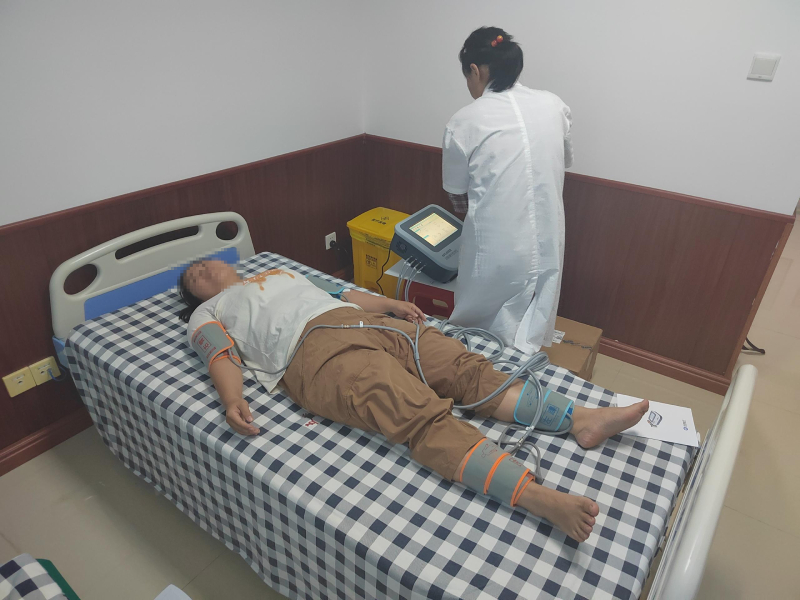
Simultaneous inflation, non-invasive measurement. The device utilises a simultaneous inflation method to measure non-invasive blood pressure in the limbs, whilst simultaneously recording and analysing the pulse waveforms of the arterial pulses in the limbs in real time. Using waveform analysis technology, it extracts characteristic information indicative of vascular elasticity and calculates multiple parameters, including the ankle-brachial index (ABI), brachial-ankle pulse wave velocity (baPWV), brachial-ankle index (BAI), heart rate (HR) and pulse volume recording (PVR).
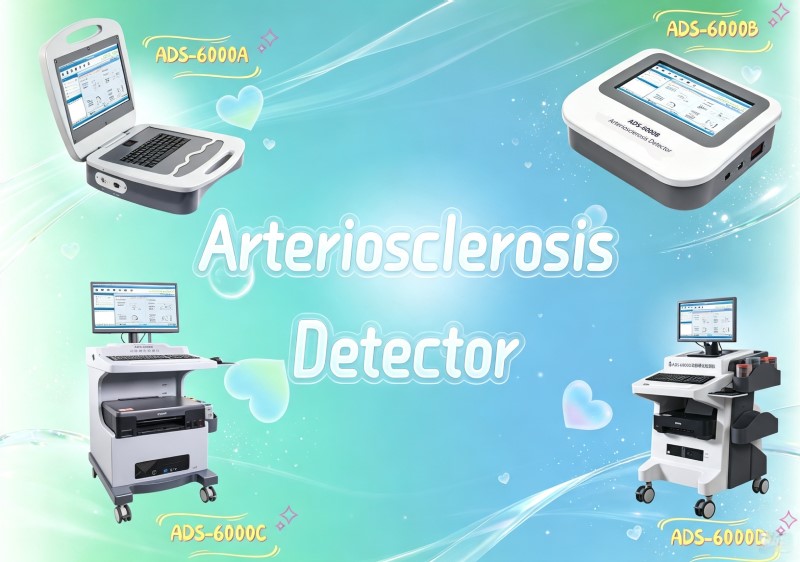
A range of product models. The ADS-6000 series comprises four models: the ADS-6000A, ADS-6000B, ADS-6000C and ADS-6000D. Of these, the ADS-6000B is a portable model, measuring just 420 × 350 × 120 mm with a net weight of 6.1 kg, enabling testing anytime, anywhere; The ADS-6000C and ADS-6000D are fully automatic trolley-mounted models, featuring an elegant and stylish design, mobility and ease of use. Different models are suited to different scenarios—whether in fixed clinical departments, mobile clinics or community screening programmes, they offer flexible options.
III. Real-world Implementation Cases: Widespread Deployment from Grade A Tertiary Hospitals to Primary Care
The ADS-6000 series has been put into use at numerous medical institutions across the country, spanning different levels from Grade A tertiary general hospitals to township health centres, thereby validating its clinical value across multiple departments.
TISCO General Hospital (Grade A tertiary) introduced the ADS-6000C in February 2025. Founded in 1952, the hospital is one of the key medical centres in Shanxi Province and indeed the North China region. The equipment is primarily used in departments such as Cardiology and the Health Check-up Centre.
Shanghai Hospital of Traditional Chinese Medicine (a Grade A Tertiary General Hospital specialising in Traditional Chinese Medicine) completed the installation of two ADS-6000D units simultaneously across its two campuses in March 2025. Thanks to its non-invasive testing capabilities and rapid, accurate results, the equipment has become a vital tool for the hospital in optimising its cardiovascular disease screening processes.
Suzhou Municipal Hospital (Grade III, Class A) completed the installation of the ADS-6000B in November 2025. Its portable design allows it to adapt flexibly to the needs of various settings, such as outpatient clinics and health check-up centres.
Shaoguan First People’s Hospital (Grade III, Class A) introduced the ADS-6000B in November 2024. The device is simple to operate and provides clear, easy-to-understand test results, significantly improving the efficiency and accuracy of cardiovascular disease diagnosis.
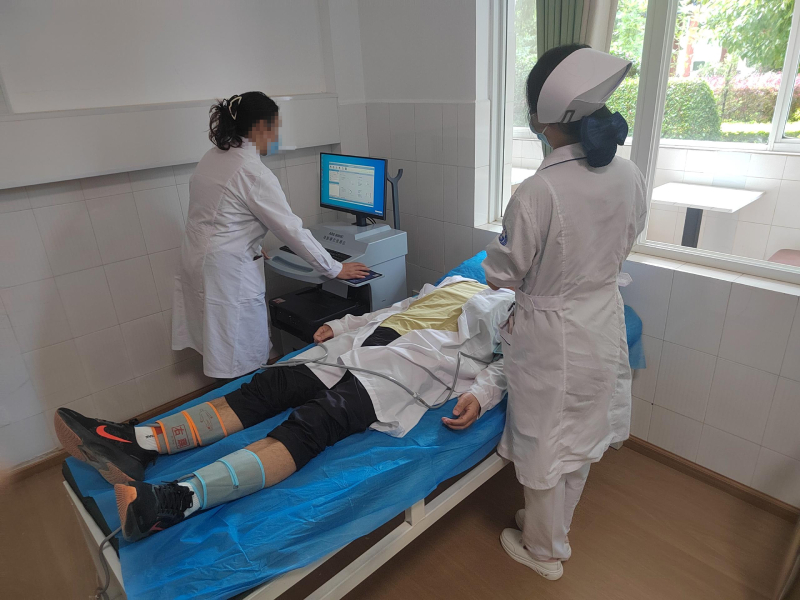
Linquan Tongsheng Hospital completed the installation of the ADS-6000C in April 2025. Qinghe County Traditional Chinese Medicine Hospital (Grade II Class A) introduced the ADS-6000B in March 2025, amongst other models.
From Grade III Class A general hospitals to Grade II Class A traditional Chinese medicine hospitals, and from county-level people’s hospitals to township health centres—the ADS-6000 series is demonstrating its clinical value across multiple departments within medical institutions at various levels.
IV. Return on Investment: How a Single Device Offers ‘Exceptional Value for Money’
For healthcare institutions, the return on investment in the ADS-6000 series is evident across multiple dimensions:
High equipment utilisation. A single device can serve multiple departments, including Cardiology, Neurology, Endocrinology, Geriatrics, Rehabilitation and Health Screening Centres, resulting in a utilisation rate far higher than that of equipment dedicated to a single department.
Low operating costs. The testing process is non-invasive and requires no consumables; a single test takes only a few minutes, making it suitable for large-scale screening and routine outpatient use. The device features a straightforward user interface and standardised procedures, allowing healthcare staff to operate it independently after a short training period.
Substantial long-term benefits. Arteriosclerosis testing has been incorporated into the cardiovascular risk screening packages of an increasing number of health check-up centres, and can become a regular fee-based service for these centres. At the same time, the device provides an objective assessment tool for chronic disease management, helping to enhance the diagnostic and treatment standards as well as the service capacity of medical departments.
The Pinyuan ADS-6000 series arterial stiffness analyser, with its ‘multi-department compatibility’ design philosophy, is helping healthcare institutions realise the procurement value of ‘one device serving the entire hospital’.
A single investment, shared across the entire hospital; one device, benefits for multiple departments.This is the Pinyuan ADS-6000 series’ best answer to the question of return on investment in medical equipment.
Post time: Aug-11-2026