

I. A widely held‘common misconception’
‘Get plenty of sun and drink plenty of milk, and you’ll have no problems with your bones.’
Almost everyone has heard this, and many even believe it wholeheartedly. When it comes to bone health, getting vitamin D from the sun and calcium from milk are indeed the two most commonly mentioned methods—and for many people, they are the only measures they take.
However, one fact that is easily overlooked is that osteoporosis is far more common than we imagine; relying solely on sun exposure and milk is far from sufficient to tackle this‘silent epidemic’.
II. The Silent Epidemic: Closer Than You Think
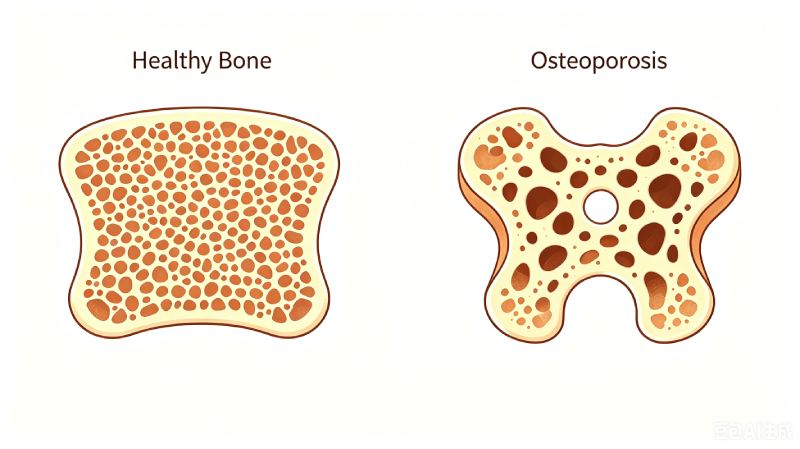
Osteoporosis is known as the‘silent disease’—it often presents no obvious symptoms in its early stages, and many people only realise their bones have become fragile once they suffer a fracture.
Data from the National Epidemiological Survey on Osteoporosis shows that the prevalence of osteoporosis among people aged 50 and over in China is 19.2 per cent, with the figure rising to 32.1 per cent among women; among those aged 65 and over, the prevalence rises to 32.0 per cent, with the figure reaching as high as 51.6 per cent among women, compared to 10.7 per cent among men.
Bone loss usually has no obvious symptoms, but as osteoporosis worsens, symptoms such as back pain, stooped posture and a loss of height may appear. However, the vast majority of people are unaware of their bone health status.
III. Why are sun exposure and drinking milk far from enough?
Regarding sun exposure—it is true that sun exposure helps the body synthesise vitamin D, which is crucial for calcium absorption. However, the reality is that vitamin D deficiency is far more widespread in China than is commonly imagined. According to the Consensus on the Clinical Application of Vitamin D and Its Analogues (2025 Edition), the prevalence of vitamin D deficiency in China stands at 61.3 per cent, whilst the prevalence of vitamin D insufficiency is as high as 91.2 per cent—meaning that nine out of every ten people are either deficient in or have insufficient levels of vitamin D. Relying solely on daily sun exposure makes it difficult to ensure an adequate intake of vitamin D.
Regarding milk consumption—whilst milk is a good source of calcium, calcium supplementation is only one aspect of bone health. Bones are dynamic, metabolising organs, and the balance between bone loss and bone formation is influenced by a combination of factors, including hormone levels, age, genetics, exercise and medication. Simply supplementing with calcium cannot resolve the issue of bone loss.
More importantly, the development of osteoporosis and reduced bone mass is a long-term, gradual process. By the time a person experiences lower back pain or a loss of height, a significant proportion of bone mass has often already been lost. It is too late to focus on bone health only after a fracture has occurred.
Whilst sun exposure and drinking milk are certainly beneficial, they cannot tell you: how much bone mass you have left; how rapidly you are losing bone mass; or how high your risk of osteoporosis is.
IV. Bone Density Testing: An Irreplaceable‘Bone Health Barometer’
Precisely because osteoporosis is asymptomatic in its early stages and progresses insidiously, bone density testing has become an irreplaceable means of assessment.
Dual-energy X-ray absorptiometry (DXA) is the internationally recognised‘gold standard’for bone density testing. Results are presented as T-scores: a T-score ≥ -1.0 is considered normal; -2.5 < T-score < -1.0 indicates reduced bone mass; and a T-score ≤ -2.5 indicates osteoporosis. The Guidelines for Osteoporosis Screening and Health Management in Health Check-up Populations (2026)explicitly recommend that imaging examinations based on bone density measurements should be used as a key tool for the assessment and diagnosis of osteoporosis.
The significance of the test lies not only in‘identifying problems’, but also in:
- Early detection: Objectively assessing skeletal health through bone density data before symptoms appear.
- Guiding intervention: Formulating targeted nutritional, exercise or pharmacological intervention plans based on the test results.
- Monitoring treatment efficacy: Regular follow-up examinations can assess the effectiveness of interventions and allow for timely adjustments to the treatment plan.
As advocated by the Chinese theme for World Osteoporosis Day 2024—‘Manage your weight, strengthen your bones’. The prerequisite for‘management’is‘knowledge’—only by understanding one’s own bone health can one manage it scientifically.
V. Incorporating Bone Density Testing into Health Management
In 2025, the National Health Commission officially issued the Guidelines on Recommended Health Examination Items for Adults (2025 Edition), explicitly including lung function tests and bone density testing for individuals aged 40 and over within the scope of basic health examinations.
Regular bone density testing is particularly important for the following groups:
People aged 40 and over—32.9 per cent of people aged 40–49 in China already have reduced bone mass; regular screening aids early detection.
People aged 50 and over—the prevalence of the condition rises significantly with age and should therefore be included in routine health checks.
Postmenopausal women—declining oestrogen levels accelerate bone loss; the prevalence among women aged 50 and over reaches 32.1 per cent.
Those with a family history of osteoporosis–genetic factors influence peak bone density and the rate of bone loss.
Those taking hormone-based medication long-term–this may affect bone metabolism.
People with low body weight–being underweight is a significant risk factor for osteoporosis and fragility fractures.
VI. Pinyuan Medical: Making Bone Density Screening More Accessible
The importance of bone density screening is becoming increasingly apparent, and the convenience of the screening process is equally crucial. Pinyuan Medical has specialised in the field of skeletal health screening for many years. It is one of the drafting organisations for the national industry standard for dual-energy X-ray absorptiometry (DXA) bone densitometers and is recognised as a national-level science and technology-based small and medium-sized enterprise.
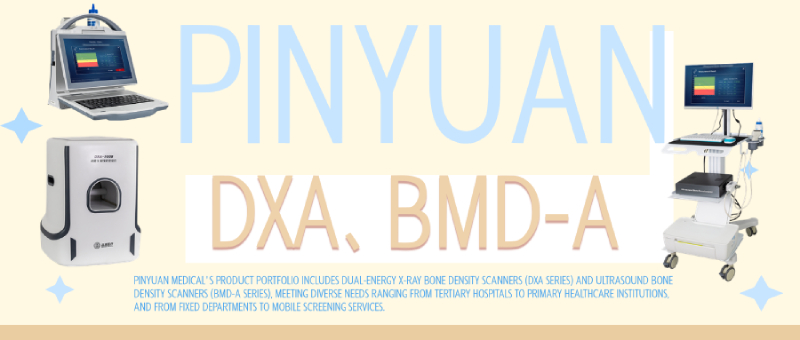
Pinyuan Medical’s product range includes dual-energy X-ray absorptiometry (DXA) bone densitometers (DXA series) and ultrasound bone densitometers (BMD-A series), capable of meeting diverse needs ranging from Grade A, Level 3 hospitals to primary healthcare facilities, and from fixed clinical departments to mobile screening units.
Pinyuan’s DXA series of dual-energy X-ray bone densitometers utilises internationally recognised DXA technology, incorporating third-generation cone-beam imaging technology and high-sensitivity digital flat-panel detectors, delivering fast imaging, high accuracy and low radiation exposure. The equipment has been deployed in hundreds of medical institutions nationwide, including Beijing Shijitan Hospital (affiliated with Capital Medical University), Xuzhou Medical University Affiliated Hospital, Jiaxing First Hospital, Lu’an People’s Hospital, Tianjin Beichen Hospital and Weifang People’s Hospital.
The Pinyuan BMD-A Series Ultrasound Bone Density Analyser utilises fully dry ultrasound technology, ensuring a procedure free from ionising radiation and non-invasive throughout. It can be flexibly deployed in settings such as community screening, rural charity clinics and rapid bedside testing. It is currently in use at numerous medical institutions nationwide, including Wuhan Central Hospital, the Air Force Specialised Medical Centre, Hubei Provincial Maternal and Child Health Hospital and Dongying People’s Hospital.
Sun exposure and drinking milk form the foundation of bone health, but they are by no means the whole story. Bone density testing is the true‘barometer’for understanding the actual condition of one’s bones.
Only through regular testing and scientific management can one truly ‘keep a close eye on’ the health of one’s bones.
Post time: Jul-21-2026