

Bone age is a key indicator for measuring the maturity of skeletal development in children and adolescents. Unlike chronological age, bone age reflects the biological age of the skeleton—it tells parents and doctors exactly how ‘old’ a child’s bones are.
The value of bone age assessment in monitoring children’s growth and development has long been widely recognised in clinical practice. On the one hand, by comparing chronological age with bone age, one can gain an immediate understanding of a child’s rate of development—if a 10-year-old child has a bone age of only 8 years, this indicates relatively delayed development; conversely, if an 8-year-old child has a bone age of 10 years, their development is relatively rapid. On the other hand, bone age assessment helps predict adult height, providing a reference for parents and children in managing height. Furthermore, in cases where skeletal development may be affected—such as idiopathic short stature or growth hormone deficiency—bone age assessment can assist doctors in early identification, enabling timely evaluation.
However, the accuracy of bone age assessment is directly linked to the reliability of the evaluation conclusions. Traditional bone age assessment relies on manual image interpretation, which is time-consuming for individual cases and the results are heavily influenced by the clinician’s experience. The Pinyuan Medical BAD-Q series X-ray bone age analysers, centred on cone-beam imaging technology and combined with multi-algorithm fusion and comprehensive radiation protection design, provide an accurate and efficient solution for assessing the growth and development of children and adolescents.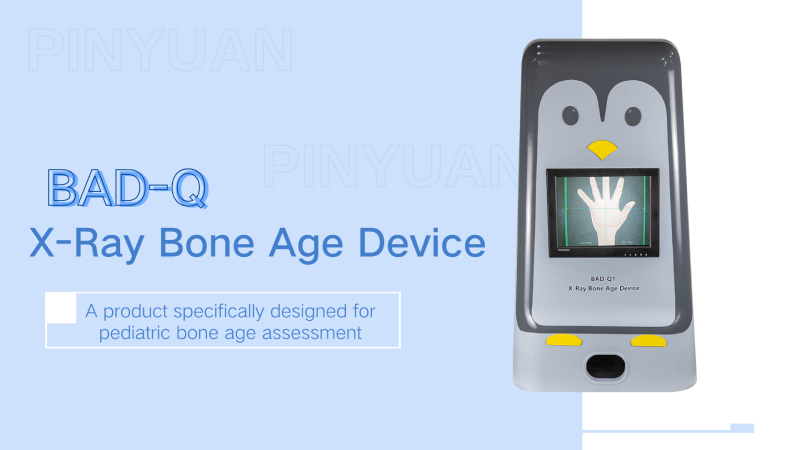
I. Cone-Beam Computed Tomography (CBCT): Making the Details of Epiphyseal Development ‘Clearly Visible’
The key to bone age assessment lies in the precise observation of the developmental details of the wrist bones. The wrist contains numerous bones at different stages of development, including the phalanges, metacarpals and carpal bones; the details of epiphyseal development in these bones clearly reflect the degree of skeletal maturity.
The Pinyuan BAD-Q series bone age analysers utilise CBCT (Cone Beam Computed Tomography) technology. This technology captures skeletal information from multiple angles and in a comprehensive manner, whilst the fully digital flat-panel detector offers high resolution and sensitivity; the two complement each other perfectly.
In terms of imaging speed, this technology offers a significant advantage—it is fast, enabling images to be acquired rapidly within a short timeframe. Regarding image quality, the images obtained are of high clarity, clearly presenting the details of epiphyseal development in the phalanges, metacarpals and carpal bones. Key structures such as the epiphyseal lines and ossification centres of the carpal and metacarpal bones are highly distinguishable.
By observing changes in the morphology, size and density of the epiphyses, doctors can more accurately determine a child’s stage of growth and development, as well as their remaining growth potential. The equipment utilises millisecond-level exposure technology, enabling rapid image acquisition the moment the child is positioned, thereby effectively reducing image blurring caused by hand movement.
Cone-beam imaging technology ensures that every subtle change in the epiphyseal line is ‘unmissable’.
II. Multi-algorithm Fusion: Ensuring Bone Age Assessment is Accurate to the Year
High-definition imaging provides the foundation for ‘clear visibility’, whilst precise assessment algorithms determine the level of ‘accuracy’ in interpretation.
The Pinyuan BAD-Q series bone age analysers integrate internationally recognised bone age assessment standards, including the TW3 method, the Chinese 05 method and other mainstream algorithms. The TW3 method, as an internationally recognised standard for bone age assessment, is underpinned by robust scientific evidence and has a broad application base; the Chinese 05 method is the Chinese industry standard for bone age assessment, specifically designed to accurately evaluate the bone age of Chinese children.
Through the integration of multiple algorithms, the device effectively minimises the errors that may arise from relying on a single algorithm. Whether children are from different ethnic groups or geographical regions, they can receive bone age test results tailored to their specific characteristics through the precise assessment provided by these diverse algorithms.
In terms of report generation, the device supports two report formats: a concise version and a detailed version. The concise version facilitates rapid diagnosis by doctors, whilst the detailed version supports in-depth assessment and analysis. The reports cover a range of core indicators, including bone age data, growth potential predictions, and recommendations for nutritional and exercise interventions.
Upon completion of the examination, bone age data is automatically calculated and reports are generated instantly, significantly reducing the lengthy examination process associated with traditional equipment. Furthermore, the device supports integration with HIS (Hospital Information Systems) and PACS (Picture Archiving and Communication Systems), enabling bone age data to be automatically uploaded to patients’ electronic health records.
III. Comprehensive Protection: Ensuring ‘Zero Anxiety’ in Paediatric Bone Age Testing
Children and adolescents are in a critical phase of growth and development and are more sensitive to radiation. The Pinyuan BAD-Q series incorporates multiple safeguards in its design.
Low-dose, low-radiation imaging. Leveraging high-sensitivity detector technology, the device can clearly visualise key structures such as epiphyseal lines even under low-dose, low-radiation conditions. Case studies from Daqing People’s Hospital show that the surface radiation levels during a single examination with the BAD-Q1 bone age analyser are essentially consistent with natural background levels, making it fully suitable for the long-term monitoring needs of children.
The entire unit features a fully enclosed lead-shielded structure, complemented by dedicated lead curtains to form a dual-layer shielding system. It can be deployed and used directly in standard consultation rooms without the need to construct a separate lead-lined shielded room. This design significantly reduces the capital expenditure on premises for healthcare institutions, making it particularly suitable for primary care facilities and health screening centres where space is limited.
Remote operation design. Operators can carry out procedures from a distance away from the radiation source, thereby ensuring their own safety whilst avoiding any disturbance to the patient.
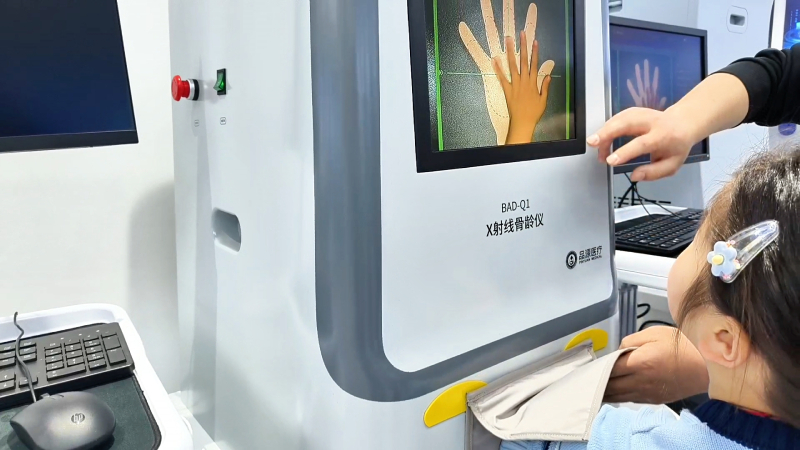
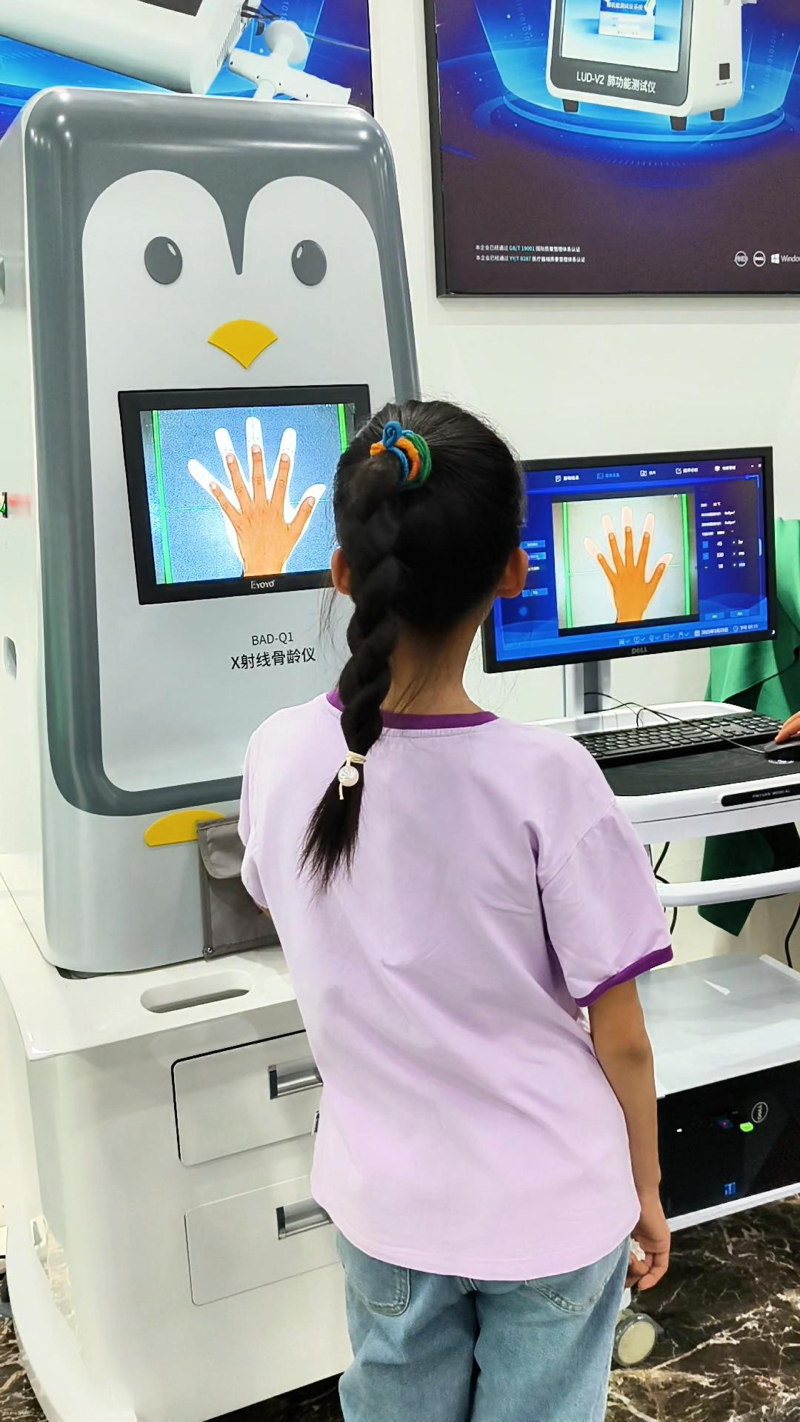
Child-friendly design. The BAD-Q1 features a cartoon penguin design in soft, soothing colours; whilst the BAD-Q2 features a cartoon panda design. This charming and comforting design effectively alleviates children’s anxiety during examinations, allowing them to complete the procedure in a relaxed and pleasant atmosphere. Furthermore, the examination parameters are specifically tailored for children to prevent overexposure.
IV. User-Friendly Operation: Making Standardised Bone Age Assessment Accessible
For primary healthcare facilities, ease of operation directly determines whether the equipment can be ‘used effectively and efficiently’.
The Pinyuan BAD-Q series is equipped with a three-point positioning system comprising hand positioning guides, real-time monitoring via a control screen, and software-based video assistance. The hand positioning guides provide clear instructions on where to place the hands; real-time monitoring on the control screen allows operators to observe hand position and the examination progress at all times; whilst the software-based video assistance guides users through correct positioning via video demonstrations.
The dual-monitor display design enables both the operator and the patient to observe the positioning simultaneously. Healthcare staff can become proficient after only a short period of training, effectively reducing reliance on senior specialist physicians.
V. From Paediatric Health Clinics to Sports Universities: Validation Across Multiple Settings
The Pinyuan BAD-Q series bone age analysers are now in use at numerous institutions nationwide, meeting the needs of different levels and settings.
Daqing People’s Hospital (Grade III, Class A) completed the installation and commissioning of the BAD-Q1 in November 2025 and officially put it into clinical use. The equipment will provide more accurate growth and health assessment services for children in Daqing and the surrounding areas, playing a crucial role particularly in the early screening of conditions such as precocious puberty and growth retardation.
Chengdu University of Physical Education successfully installed the BAD-Q1 bone age analyser in September 2025. In the development of the sports industry, precise bone age assessment can overcome the limitations of talent selection based solely on external indicators such as age, height and weight, thereby enabling a deeper exploration of the growth and development potential of young athletes. By assessing an athlete’s skeletal maturity through bone age testing, targeted training programmes can be devised—for young athletes whose skeletons have not yet fully matured, this helps prevent skeletal injuries caused by overtraining.
In September 2025, Wei County Dazhong Hospital completed installation and training for the BAD-Q2. Its panda-themed design and paediatric-specific parameter settings take full account of children’s psychological and physiological characteristics.
Furthermore, the Pinyuan BAD-Q series bone age analysers have obtained medical device registration certificates and are widely used in paediatric departments of medical institutions at all levels, children’s hospitals, health check-up centres and adolescent health management organisations. As medical equipment with independent intellectual property rights, the product range is available across all 31 provinces, autonomous regions and municipalities directly under the central government.
From high-definition imaging to multi-algorithm fusion, from low-dose radiation protection to lead-free room deployment, from Grade A tertiary hospitals to sports universities—Pinyuan’s BAD-Q series bone age analysers use cone-beam imaging technology to ‘see’ the growth of every child.
Post time: Jul-04-2026