

The China Cardiovascular Health and Disease Report 2024, published by the National Centre for Cardiovascular Diseases, reveals that cardiovascular disease (CVD) remains the leading cause of death among both urban and rural residents in China. In 2021, CVD accounted for 48.98 per cent and 47.35 per cent of deaths in rural and urban areas respectively, meaning that approximately two in every five deaths were attributable to CVD. In 2023, the crude incidence rate of CVD among Chinese residents aged 18 and over was 620.33 per 100,000; this figure stood at 717.36 per 100,000 for men and 519.64 per 100,000 for women, with incidence rates showing a significant upward trend with increasing age. The incidence of cardiovascular disease begins to rise from the early 30s onwards, becoming more pronounced in people in their 50s and 60s. Atherosclerosis, as a key pathological basis for major cardiovascular and cerebrovascular events such as myocardial infarction and stroke, often presents with very subtle early symptoms; many patients only become aware of the problem once a serious event has occurred.
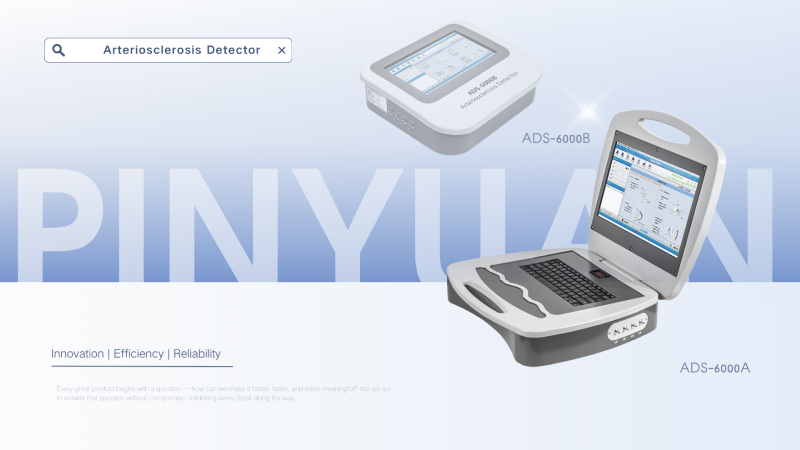
How can the early detection and precise assessment of atherosclerosis be achieved? The Pinyuan Medical ADS-6000 series atherosclerosis analyser, with its three key technical features—non-invasive detection, synchronous pressurisation and four-limb measurement—provides clinicians with a ‘one-stop assessment’ solution for vascular health.
I. Core Principle: Synergistic Assessment of PWV and ABI
Pinyuan’s arterial stiffness analyser centres on two core indicators—pulse wave velocity (PWV) and ankle-brachial index (ABI)—to form a ’velocity‘–’pressure’ two-dimensional assessment model.
PWV–the ’speedometer’ of vascular elasticity. As an indicator for detecting arterial stiffness explicitly recommended in the 2003 European Hypertension Guidelines, PWV quantifies the stiffness of the arterial wall by measuring the speed at which the pulse wave travels through the arteries. Its principle is based on the physical relationship between the modulus of elasticity and wave velocity; a higher value indicates poorer vascular elasticity. To put it simply: PWV directly reflects the stiffness of the arteries; the faster the speed, the more advanced the atherosclerosis, with the blood vessels resembling a rubber tube that has lost its elasticity, becoming stiff and fragile.
ABI–the ‘pressure gauge’ of peripheral circulation. The ABI screens for lower limb arterial disease by calculating the ratio of systolic blood pressure at the ankle to that at the upper arm. The ABI is primarily used to screen for lower limb arterial disease; an abnormally low ABI value typically indicates a possible narrowing or blockage in the lower limb arteries. An ABI of ≤0.9 suggests peripheral arterial occlusion, whilst an ABI of >1.3 may indicate arterial calcification. Clinical studies have confirmed that lower limb arterial lesions share a high degree of homology with coronary artery disease; individuals with abnormal ABI values have a three- to four-fold increased risk of developing coronary heart disease in the future.
These two indicators complement one another: PWV assesses vascular elasticity, whilst ABI assesses blood flow patency, together enabling a comprehensive assessment of vascular health. Through the combined assessment of these two indicators, the Pinyuan Arteriosclerosis Detector enables a comprehensive evaluation ranging from ‘localised lesions’ to ‘systemic arteriosclerosis’.
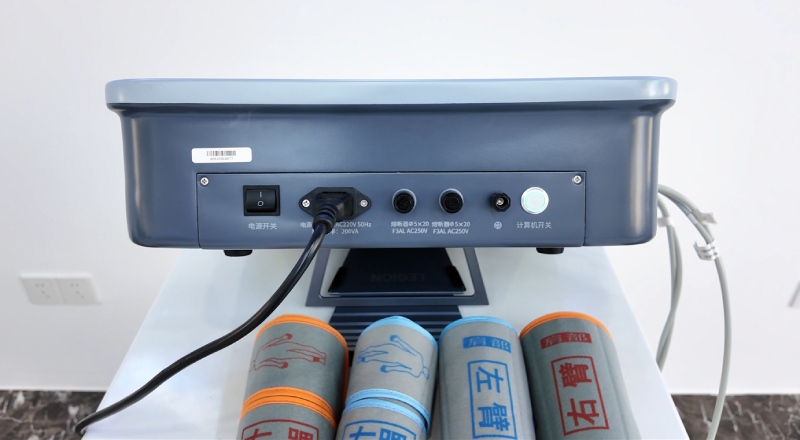
II. Testing Method: Non-invasive·Simultaneous Pressurisation·Four-Limb Measurement
The operation of the Pinyuan ADS-6000 series Arteriosclerosis Detector is similar to that of conventional blood pressure measurement; the entire process is non-invasive and radiation-free, resulting in high patient acceptance. The device utilises synchronous inflation to measure blood pressure in all four limbs, whilst simultaneously recording and analysing the arterial pulse waveforms in real time.
A complete examination takes only a few minutes; the patient simply lies supine on the examination bed with blood pressure cuffs secured to both upper arms and ankles, whilst the device automatically handles inflation, deflation and data collection.
Key measurement parameters include:
baPWV (brachial-ankle pulse wave velocity)
ABI (ankle-brachial index)
BAI (brachial-abdominal index)
HR (heart rate)
PVR (pulse volume recording)
Systolic, diastolic and mean blood pressure, and pulse pressure in all four limbs
The device performs automatic analysis and comprehensive assessment using database information, enabling evaluation of cardiovascular health and the degree of lower limb arterial occlusion.
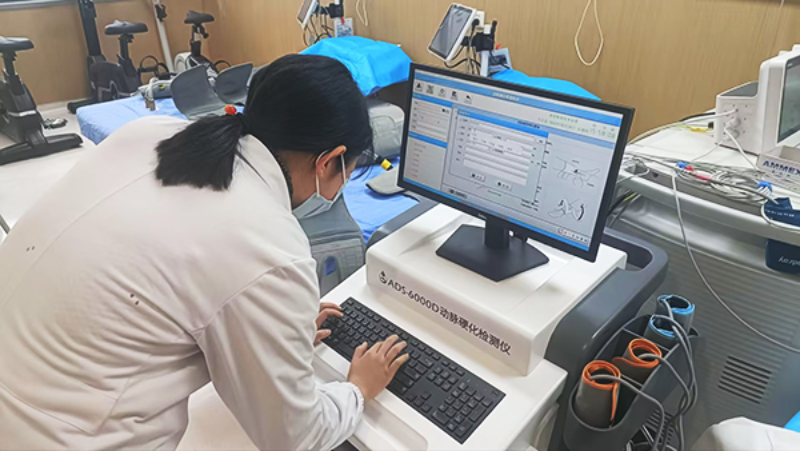
III. Clinical Value Across Multiple Departments: From Cardiology to Health Screening Centres
The early screening and dynamic monitoring of atherosclerosis involve multiple clinical departments. Designed with ‘ease of use, rapid testing and reliable results’ as its guiding principles, the Pinyuan Atherosclerosis Detector is tailored to meet the clinical needs of various departments.
Cardiology is the core department for the diagnosis and treatment of vascular diseases. The Pinyuan Arteriosclerosis Detector supports the measurement of both PWV and ABI; PWV values reflect arterial elasticity, whilst ABI indicates the degree of lower limb vascular obstruction, providing an objective basis for the assessment of vascular-related conditions such as coronary heart disease and peripheral arterial disease.
The Department of Neurology requires a comprehensive understanding of patients vascular status to predict the risk of stroke. The comprehensive analysis function of the Pinyuan Arteriosclerosis Detector provides a ‘multi-dimensional vascular profile’, assessing carotid artery elasticity via PWV and combining this with ABI to determine the degree of systemic vascular hardening. For patient groups with conditions such as hypertension and hyperlipidaemia, the device can serve as a tool for regular monitoring.
The Department of Endocrinology deals with diabetic patients, a high-risk group for arteriosclerosis. Chronic hyperglycaemia in diabetic patients can easily damage the vascular endothelium, necessitating frequent and convenient testing tools for long-term management. The Pinyuan Arteriosclerosis Detector features a standardised operating procedure with simultaneous pressure application to all four limbs, enabling the rapid generation of colour reports containing waveforms and parameters.
Geriatrics serves a population with a high prevalence of arteriosclerosis. Older adults often have comorbidities such as hypertension and diabetes, requiring long-term monitoring of their vascular condition. Reports from the Pinyuan Arteriosclerosis Detector include risk alerts and recommendations.
Health screening centres need to meet the demands of large-scale population screening. Arteriosclerosis testing can serve as a core component of cardiovascular and cerebrovascular risk screening, helping individuals undergoing health checks to detect potential vascular issues at an early stage.
From testing principles to clinical application, and from Grade A tertiary hospitals to primary care facilities, the Pinyuan Arteriosclerosis Detector provides a practical solution for vascular health assessment through its non-invasive, synchronous inflation and four-limb measurement technology.
IV. Real-world Implementation Cases: Widespread Adoption from Grade A Tertiary Hospitals to Primary Care
The Pinyuan Arteriosclerosis Detector has been put into use in numerous medical institutions across the country, meeting clinical needs at different levels and across various departments.
Taigang General Hospital (Grade A Tertiary) introduced the Pinyuan ADS-6000C Arteriosclerosis Detector in February 2025 for use in departments such as Cardiology and the Health Check-up Centre. Founded in 1952, the hospital is one of Shanxi Province’s key medical centres.
Suzhou Municipal Hospital (Suzhou Hospital Affiliated to Nanjing Medical University, Grade A Tertiary) completed the installation and commissioning of the Pinyuan ADS-6000B Portable Arteriosclerosis Detection System in November 2025. Its portable design allows for flexible adaptation to the needs of various settings, such as outpatient clinics and health screening centres.
Shanghai Hospital of Traditional Chinese Medicine (a Grade III Class A comprehensive TCM hospital) completed the installation of two ADS-6000D units across both of its campuses in March 2025.
Furthermore, Linquan Tongsheng Hospital completed the installation of the ADS-6000C in April 2025; Hexi Township Health Centre has also introduced the ADS-6000B.
From Grade A, Level 3 general hospitals to county-level people’s hospitals, and from cardiology departments to health screening centres, Pinyuan’s arterial stiffness detection devices are proving their value across medical institutions at various levels.
V. Which groups are advised to undergo regular screening?
Based on clinical recommendations from the installation case study at Yongde County People’s Hospital, the following groups should undergo regular atherosclerosis screening:
Middle-aged and elderly individuals: Men aged 45 and over and women aged 55 and over are advised to undergo regular screening.
Patients with chronic conditions: Those with hypertension, diabetes or hyperlipidaemia should include atherosclerosis screening as part of their routine check-ups.
Individuals with unhealthy lifestyle habits: Those who are long-term smokers, obese or physically inactive.
Those with a family history: Individuals with first-degree relatives who have arteriosclerosis-related conditions (such as coronary heart disease or cerebral infarction).
For the above groups, regular arteriosclerosis screening helps to detect vascular lesions at an early stage and enables timely intervention.
The Pinyuan ADS-6000 series arteriosclerosis analyser—non-invasive, synchronous pressurisation, and four-limb measurement—provides a one-stop assessment solution for vascular health.
Post time: Jul-01-2026