

‘I’m getting on in years, so I’ve lost a bit of height.’
Do you often hear older people around you making this self-deprecating remark? Or perhaps you’ve even noticed yourself that you’re a bit shorter now than you were in your youth. Many people dismiss this as a ‘normal physiological phenomenon’ and laugh it off.
However, this view is not only incorrect but also signals a significant health risk. A loss of height is very likely a sign that bone mass is being lost.
I. A Health Problem More Prevalent Than You Might Think
Behind this loss of height often lies a ‘silent epidemic’—osteoporosis.
The Epidemiological Survey Report on Osteoporosis in China reveals that the prevalence of osteoporosis among people aged 50 and over in China stands at 19.2 per cent, with the figure rising to 32.1 per cent among women; among those aged 65 and over, the prevalence is 32.0 per cent, with women accounting for as high as 51.6 per cent and men 10.7 per cent. Based on these figures, it is estimated that there are currently around 90 million people suffering from osteoporosis in China.
However, public awareness of osteoporosis remains very low. The vast majority of people are unaware of their own bone health. By the time they pay attention to their bone health after noticeable symptoms appear, a significant proportion of bone mass has often already been lost.
II. Why Do We Lose Height? Our Bones Are ‘Collapsing’
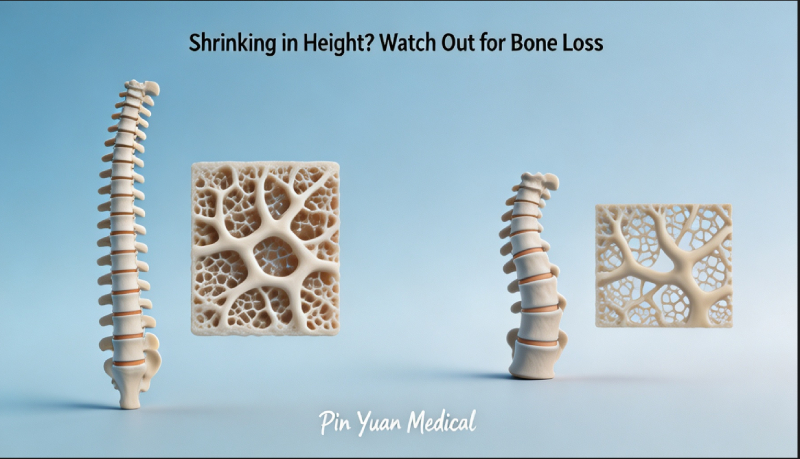
Our spine is composed of stacked vertebrae, acting like a ‘load-bearing column’. Inside the bones are a dense network of trabecular structures, akin to the reinforcing bars in a building, which provide the bone’s strength.
When osteoporosis occurs, these trabecular structures are damaged, reducing the bone’s load-bearing capacity. Under the long-term pressure of body weight, the vertebral bodies are gradually compressed, leading to compression fractures.
If measurements reveal a loss of height of more than 3 centimetres (roughly the width of two fingers) compared to your height in youth, or if you notice your stoop becoming increasingly severe—forming what is known as ‘senile kyphosis’—this is highly likely to be the result of multiple vertebral compression fractures.
Research indicates that a single vertebral compression fracture may reduce height by approximately 2 millimetres, whilst fractures affecting multiple segments can lead to significant postural changes and functional limitations.
Vertebral compression fractures are the most common type of fracture caused by osteoporosis. Once a vertebral compression fracture occurs, it indicates that bone loss has progressed to a considerable degree. Without effective treatment, the risk of fracture within three years following an accidental fall can be as high as 50–80 per cent.

III. Apart from a loss of height, what other warning signs are there?
Apart from a ‘shrinking’ height, the following signs also warrant attention:
Unexplained lower back pain. Persistent, diffuse and intermittent dull pain in the lower back or spine, which is particularly exacerbated after prolonged sitting or standing. This pain is often caused by a reduction in the load-bearing capacity of the vertebrae following bone loss, leading to microscopic ‘microfractures’ within the bone.
Fractures caused by minor trauma. Falling from a standing position resulting in a wrist or hip fracture, experiencing severe rib pain from a simple sneeze, or even feeling intense lower back pain when bending over to pick up a child—these are all typical manifestations of ‘fragility fractures’.
Nocturnal cramps and general weakness. Frequent calf cramps at night may be a sign of disturbances in the body’s calcium and phosphorus metabolism.
IV. Bone Density Testing: Keeping Track of Your Bone Health
Precisely because osteoporosis is asymptomatic in its early stages and progresses insidiously, bone density testing has become an indispensable means of assessment.
Dual-energy X-ray absorptiometry (DXA) is recognised by the World Health Organisation (WHO) as the ‘gold standard’ for diagnosing osteoporosis. By measuring bone mineral content, it accurately determines the extent of bone loss. Test results are presented as T-scores: a T-score of ≥-1.0 is considered normal; a T-score of -2.5 < T-score < -1.0 indicates reduced bone mass (low bone mass); and a T-score of ≤-2.5 indicates osteoporosis.
By 2025, bone density testing had been incorporated into routine health check-ups. Regular bone density testing is particularly important for people aged 40 and over, postmenopausal women, those with a family history of osteoporosis, those on long-term hormone therapy, and individuals with low body weight:
V. Pinyuan Medical: Making Bone Density Testing More Accessible
The importance of bone density testing is becoming increasingly apparent, and accessibility to such testing is equally crucial.
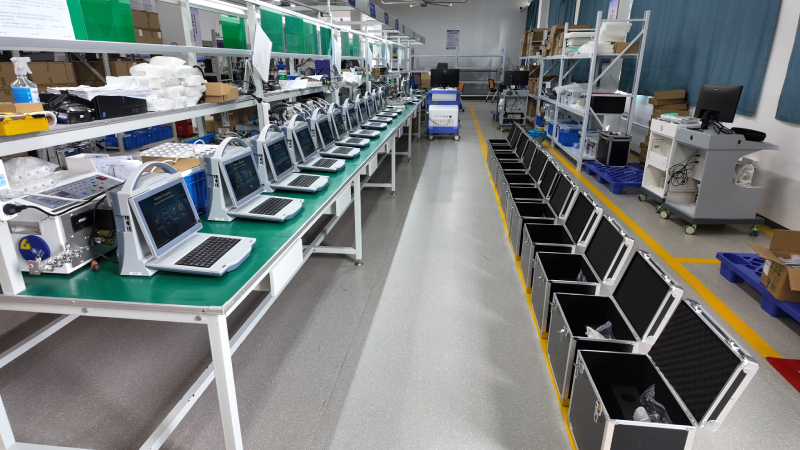
Pinyuan Medical has specialised in the field of skeletal health screening for many years and is one of the drafting organisations for the national industry standard for dual-energy X-ray absorptiometry (DXA) scanners. Pinyuan’s DXA series of dual-energy X-ray absorptiometry scanners utilises internationally recognised DXA technology, incorporating third-generation cone-beam imaging technology and high-sensitivity digital flat-panel detectors, offering fast imaging, high precision and low radiation exposure. The equipment has been deployed in hundreds of medical institutions nationwide, including Beijing Shijitan Hospital Affiliated to Capital Medical University and the Affiliated Hospital of Xuzhou Medical University.
The Pinyuan BMD-A Series Ultrasound Bone Density Analyser utilises fully dry ultrasound technology, is completely free from ionising radiation and non-invasive throughout the procedure, and weighs just 4.3 kg, making it ideal for flexible deployment in settings such as community screening, rural charity clinics and rapid bedside testing.
A gradual loss of height is not simply a natural phenomenon associated with ageing, but a clear sign of bone loss.
Every 3-centimetre reduction in height may indicate that multiple vertebrae have already suffered compression fractures.
Post time: Aug-06-2026