

Do you feel a tightness in your chest and find it hard to catch your breath after climbing just a few flights of stairs? Or do your calves feel sore and swollen after walking only a short distance, forcing you to stop and rest? Many people attribute such discomfort to ‘getting on in years’, ‘a lack of exercise’ or ‘not having had enough rest recently’. Yet these seemingly ordinary physical signals are sometimes, in fact, ‘warnings’ sent out by your blood vessels.
I. A Severely Underestimated Health Threat
Atherosclerosis refers to the process whereby the walls of arteries thicken, harden and lose their elasticity. It does not occur overnight, but is the result of a slow accumulation of factors such as lipid deposits and inflammatory responses on the inner walls of blood vessels.
This process can occur in blood vessels throughout the body—when it occurs in the heart, it may lead to coronary atherosclerotic heart disease; when it occurs in the brain, it may trigger a stroke; and when it occurs in the legs, it may result in peripheral arterial disease.
The China Cardiovascular Health and Disease Report 2023 reveals that the prevalence of cardiovascular disease in China continues to rise, with an estimated 330 million people currently affected. Of these, approximately 45.3 million suffer from peripheral arterial disease. A noteworthy statistic is that the number of people with peripheral arterial disease exceeds the combined total of those with coronary heart disease and stroke.
Atherosclerotic cardiovascular disease is a major contributor to the mortality burden of cardiovascular disease. It is preventable and manageable, but the level of control over key risk factors still needs to be improved.
However, the early stages of atherosclerosis often present no obvious symptoms. By the time many people experience noticeable discomfort, the vascular lesions have already progressed to a certain extent.
II. Chest tightness when climbing stairs, aching legs when walking – what exactly is going on?
Chest tightness when climbing stairs – the heart’s blood vessels are ‘calling for help’
When climbing stairs, the heart needs to work harder to supply blood to the whole body. If atherosclerotic plaques have already formed in the coronary arteries, causing narrowing of the vessel lumen, the blood flow cannot meet the demands of the heart muscle during exercise, leading to symptoms such as chest tightness, shortness of breath and a feeling of pressure in the chest.
This is, in fact, one of the typical manifestations of myocardial ischaemia.
Sore legs whilst walking — the blood vessels in your legs are ‘sending out an alarm’
If your legs feel sore, swollen or painful after walking a certain distance, and these symptoms ease after a few minutes’ rest only to reappear when you walk again — this condition is medically known as ‘intermittent claudication’ and is a typical manifestation of peripheral arterial disease.
Peripheral arterial disease is a localised manifestation of systemic atherosclerosis in the limbs; narrowing or even blockage of the arterial lumen leads to corresponding symptoms of ischaemia in the limbs. Among people aged 60 and over in China, one in five may suffer from peripheral arterial disease. Over 60 per cent of patients, having ignored the early symptoms, ultimately face the risk of amputation or even life-threatening complications.
What is even more cause for concern is that the early stages of lower limb atherosclerotic occlusive disease often present as a sensation of coldness, numbness and leg muscle cramps; these early symptoms are not typical and are easily mistaken for ‘calcium deficiency’ or ‘lumbar spine disorders’, leading to misdiagnosis and inappropriate treatment.
III. Two indicators that clearly reveal the condition of your blood vessels
Although atherosclerosis is insidious, it can be assessed using objective indicators.
Commonly used clinical assessment indicators include pulse wave velocity (PWV) and the ankle-brachial index (ABI).
Pulse wave velocity (PWV) – a classic indicator for assessing arterial stiffness. In healthy individuals, blood vessels are elastic, like rubber tubing; pulse wave fluctuations are absorbed by the vessel walls, resulting in a slower propagation speed. In contrast, in patients with atherosclerosis, the blood vessels harden, resembling clay pipes; the fluctuations are not absorbed by the vessel walls, leading to a faster propagation speed. By measuring PWV, the degree of arterial stiffness can be determined.
Ankle-brachial index (ABI) — the ratio of blood pressure at the ankle to that at the upper arm. The ABI is primarily used to assess whether there is narrowing or blockage in the lower limb arteries. An ABI below 0.9 suggests a possible lower limb arterial disease.
PWV and ABI are complementary indicators — PWV assesses vascular elasticity, whilst ABI assesses blood flow patency; together, they provide a comprehensive assessment of vascular health.
IV. Which groups of people need to pay attention to their vascular health?
The following groups should pay particular attention to their vascular health:
- People aged 40 and over — the risk of atherosclerosis rises significantly with age. A study of 4,479 individuals undergoing health check-ups showed that the detection rate of atherosclerosis was 18.91 per cent among those aged 40 and under, whilst it rose to 72.40 per cent among those aged 40 to 60.
- People with hypertension — long-term high blood pressure damages the vascular endothelium and accelerates the progression of atherosclerosis.
- People with diabetes — High blood glucose levels can directly damage the blood vessel walls.
- People with hyperlipidaemia — Dyslipidaemia is a major risk factor for atherosclerosis.
- Long-term smokers — Smoking is one of the major risk factors for atherosclerosis.
- People with a family history of cardiovascular disease — Genetic factors should not be overlooked.
For the aforementioned groups,regular screening for arterial stiffness helps to detect early changes in blood vessels before obvious symptoms appear.
V. Pinyuan ADS-6000 Series: Providing a ‘Scientific Basis’ for Vascular Health
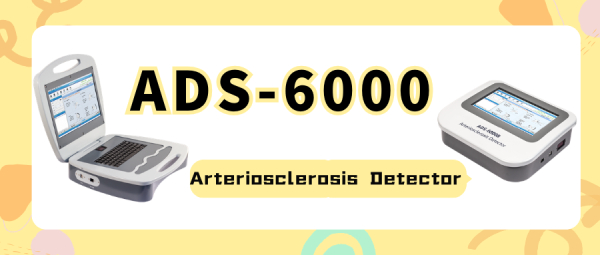
The assessment of vascular health relies on specialised diagnostic equipment. The Pinyuan Medical ADS-6000 Series arterial stiffness analyser provides clinicians with a non-invasive, highly efficient solution for assessing vascular health.
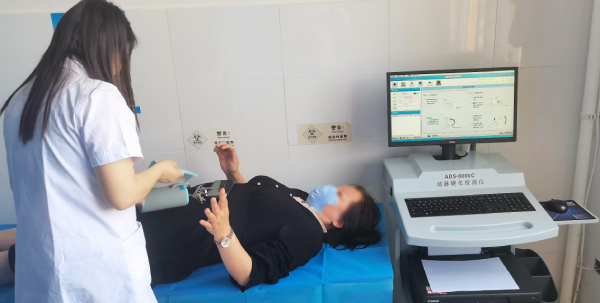
Non-invasive testing places no burden on patients. The testing process is similar to routine blood pressure measurement. The patient simply lies on their back, with blood pressure cuffs secured to both upper arms and ankles, and the device automatically completes the measurement. The entire process is non-invasive and radiation-free.
Simultaneous inflation for four-limb measurement. The device uses a synchronous inflation method to non-invasively measure blood pressure in all four limbs, whilst recording and analysing arterial pulse waveforms in real time.
Dual-parameter assessment, providing a comprehensive picture of vascular health. Key parameters measured by the device include baPWV (brachial-ankle pulse wave velocity), ABI (ankle-brachial index), BAI (brachial-waist index), HRI (heart rate), and PVR (pulse volume recording), amongst others. Using waveform analysis technology, the device extracts characteristic information indicative of vascular elasticity and calculates multiple indices.
User-friendly operation with rapid report generation. A complete examination takes only a few minutes, with the device automatically performing data collection and comprehensive analysis.
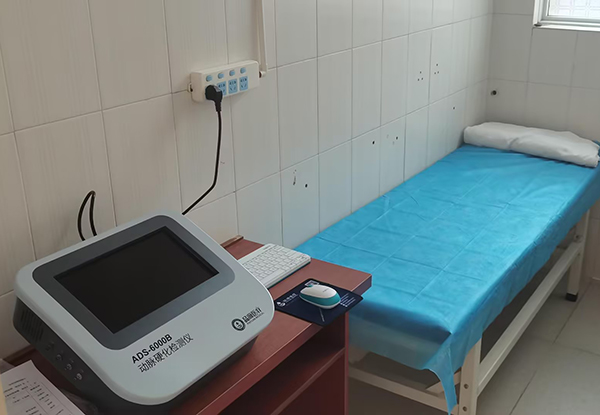
Multiple models to suit different settings. The ADS-6000 series offers a range of models: the ADS-6000B is a portable unit, measuring just 420 × 350 × 120 mm, allowing examinations to be conducted anytime, anywhere;
Widespread adoption and clinically validated. The ADS-6000 series is already in use at numerous medical institutions across the country—TISCO General Hospital (Grade III, Class A) introduced the ADS-6000C in February 2025; Suzhou Municipal Hospital (Grade III, Class A) completed the installation of the ADS-6000B in November 2025; Shanghai Hospital of Traditional Chinese Medicine (Grade III, Class A comprehensive TCM hospital) simultaneously installed two ADS-6000D units across its two campuses in March 2025; Baoshan Second People’s Hospital in Yunnan Province completed the installation of the ADS-6000D in September 2024; Yongde County People’s Hospital (Grade II Class A) completed the installation of the ADS-6000D in July 2025. In addition, institutions such as Shaoguan First People’s Hospital, Linquan Tongsheng Hospital, Qinghe County Hospital of Traditional Chinese Medicine and Hexi Township Health Centre have also completed installations.
Shortness of breath when climbing stairs, aching legs when walking – these seemingly ordinary physical signals may be your blood vessels ‘sounding the alarm’. Arteriosclerosis is insidious and progressive, but through scientific diagnostic methods, early detection and assessment are entirely possible.
Pay attention to every signal your body sends and take every assessment of your vascular health seriously – so that you have a clear understanding of your blood vessels’ condition and a solid basis for your health.
Post time: Aug-01-2026