

In orthopaedic wards, geriatric wards, rehabilitation departments and intensive care units, a certain category of patients faces a constant dilemma: they require regular monitoring of their bone density—as prolonged bed rest accelerates bone loss, leaving them at high risk of osteoporotic fractures; yet they also find it difficult to undergo bone density testing — traditional testing equipment is fixed in radiology departments or dedicated examination rooms, requiring patients to be transferred from their beds to the examination room, a process that is time-consuming and labour-intensive, and may even exacerbate their condition during transport.
A real clinical dilemma is that the very people who need testing the most find it the hardest to undergo.
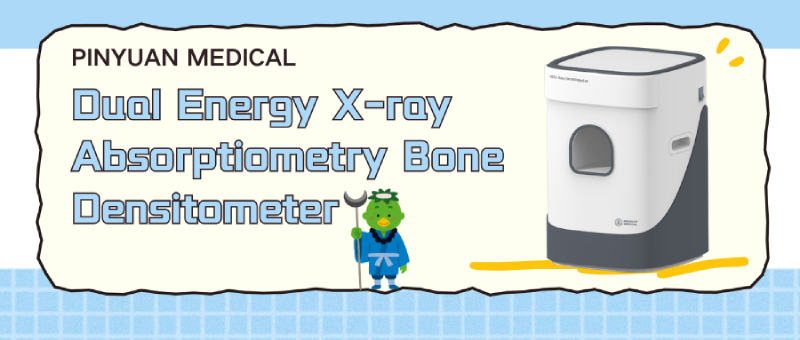
To address this challenge, Pinyuan Medical has independently developed the DXA-500A portable dual-energy X-ray absorptiometry (DXA) scanner. With its compact 19.8 kg chassis, lead-free design, battery life of over 10 hours and remote operation mode, it ‘liberates’ professional-grade bone density testing from the radiology department and brings it directly into the ward. Currently, the device has been deployed in numerous medical institutions, including the Affiliated Hospital of Xuzhou Medical University, Jingjiang Traditional Chinese Medicine Hospital and a specialist hospital in Hebei Province. It provides a ‘bedside’ screening solution for bedridden critically ill patients, elderly people with limited mobility, and patients requiring close monitoring of bone density following surgery.
I. Why is bedside bone density screening an ‘essential need’?
Osteoporosis is known as the ‘silent bone killer’; whilst it presents no obvious symptoms in its early stages, it can quietly erode bone health and lead to serious complications such as fractures, posing a particularly significant risk to the elderly and patients with limited mobility. Accurate bone density testing is a key prerequisite for early detection and clinical intervention.
However, for a long time, bone density testing has faced a structural dilemma:
The conflict between fixed equipment and mobile patients. Traditional dual-energy X-ray absorptiometry (DXA) scanners are bulky, require dedicated lead-lined rooms, and are permanently installed in radiology departments or specialised examination rooms. Patients must be transported in wheelchairs or on hospital beds between their wards and the examination room, a process that is both time-consuming and labour-intensive. For patients recovering from fractures or those who are critically ill and bedridden, every such transfer may impose an additional physical burden.
The conflict between the demand for frequent monitoring and the limited availability of testing. The treatment of osteoporosis often requires long-term, continuous medication, and regular bone density testing is crucial for monitoring treatment efficacy and adjusting treatment plans. However, the traditional testing process is cumbersome, and both patients and departments find it difficult to cope with the frequent transfers and appointments required.
The DXA-500A was developed precisely to resolve this conflict.
II. 19.8 kg: Bringing a Bone Densitometer ‘Into the Ward’
The DXA-500A represents a breakthrough in portability and adaptability to different clinical settings.
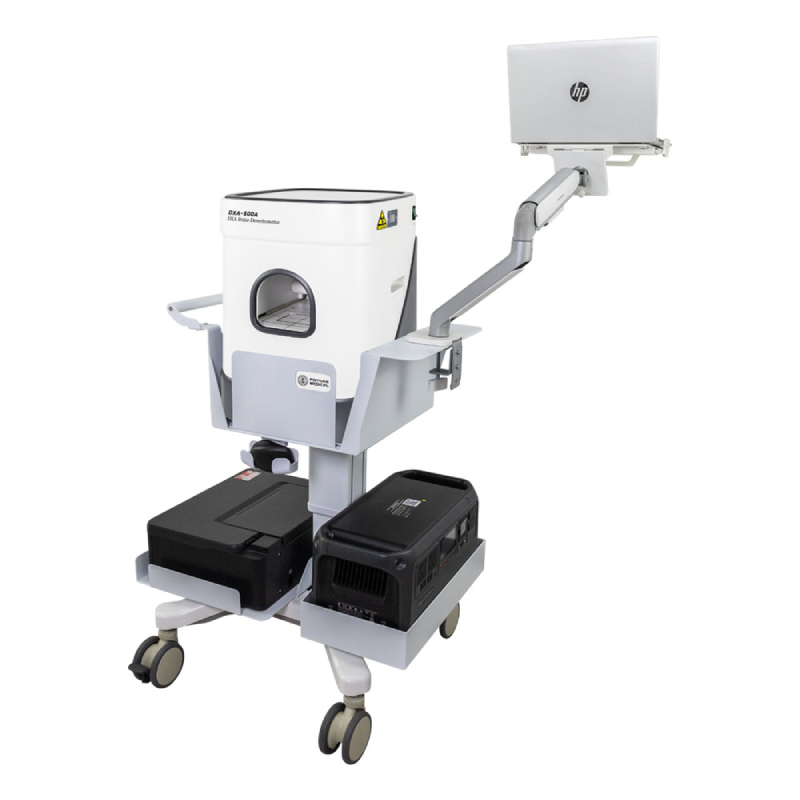
A lightweight chassis weighing just 19.8kg. Weighing only 19.8kg, the device can be easily pushed or moved by a single healthcare professional without the need for assistance. Equipped with a custom-designed protective base and an electric height-adjustable trolley, it can manoeuvre flexibly between different clinical areas and adapt to beds of varying heights.
Lead-free design, suitable for deployment in standard wards. Traditional dual-energy X-ray bone densitometers require the construction of dedicated lead-lined rooms, resulting in high venue costs and lengthy deployment times. The DXA-500A utilises fully enclosed radiation shielding technology and multiple built-in protective structures, eliminating the need for a dedicated lead-lined room or complex modifications to the examination area. It can be rapidly deployed in standard wards or screening centres.
With a battery life of over 10 hours, it frees users from the constraints of mains power. The device is equipped with a high-performance portable power bank, enabling continuous and stable operation for over ten hours on a single charge. There is no need to rely on fixed power sockets, allowing examinations to be carried out anytime, anywhere.
Remote operation via a host unit and laptop ensures staff remain clear of the radiation source throughout the process. An innovative design combining a host unit and a laptop enables remote operation. Medical staff can complete the entire process—including parameter settings and initiating scans—without needing to be present at close range at the examination site.
Switch between wired and wireless modes. The device supports seamless switching between wired and wireless measurement modes. Wired mode can be selected in healthcare facilities where cabling is convenient, whilst wireless mode can be used in scenarios such as mobile clinics and primary healthcare centres.
III. Less than 4 seconds: DXA ‘gold standard’ technology, combining speed and accuracy
Portability does not mean sacrificing accuracy. The DXA-500A utilises the internationally recognised dual-energy X-ray absorptiometry (DXA) method—the ‘gold standard’ technology for clinical diagnosis.
Rapid scanning in less than 4 seconds. The device integrates cone-beam imaging technology with specialised compensation algorithms to achieve rapid scanning in under 4 seconds. This advantage is particularly evident in clinical testing scenarios—patients do not need to maintain a fixed posture for extended periods, making it especially suitable for those with limited mobility, such as the elderly, post-operative patients and bedridden individuals.
Accurate output of core indicators such as T-scores and Z-scores. Measurement results can be used directly as a basis for the WHO diagnostic criteria for osteoporosis, accurately providing bone mineral density values, T-scores, Z-scores and other indicators. The test report clearly presents core data, which can be used directly for clinical diagnosis and monitoring of treatment efficacy.
Segmented locking and zoned display of regions of interest. The device automatically identifies and locks onto key examination areas at the distal ends of the ulna and radius in the forearm, whilst also supporting the zoned display of bone density values. This refined analytical approach breaks down complex skeletal data into clear and easily understandable segmented indicators, helping clinicians to quickly pinpoint skeletal health issues.
Triple positioning system ensures data comparability. The device innovatively employs a triple positioning assurance system comprising ‘physical grip + video monitoring + positioning lines’. A dedicated ergonomic handle guides patients into a natural and standardised position; high-definition video monitoring captures postural deviations in real time; and clear positioning lines provide an intuitive visual reference. The synergistic action of these three elements ensures consistent positioning for every scan, enhancing data repeatability and comparability, making it particularly suitable for long-term monitoring of changes in patients’ bone health.
IV. Real-world Implementation Cases: Widespread Adoption from Grade A Tertiary Hospitals to Specialised Centres
The DXA-500A has been put into service at numerous medical institutions across the country, validating its clinical value in bedside testing scenarios.
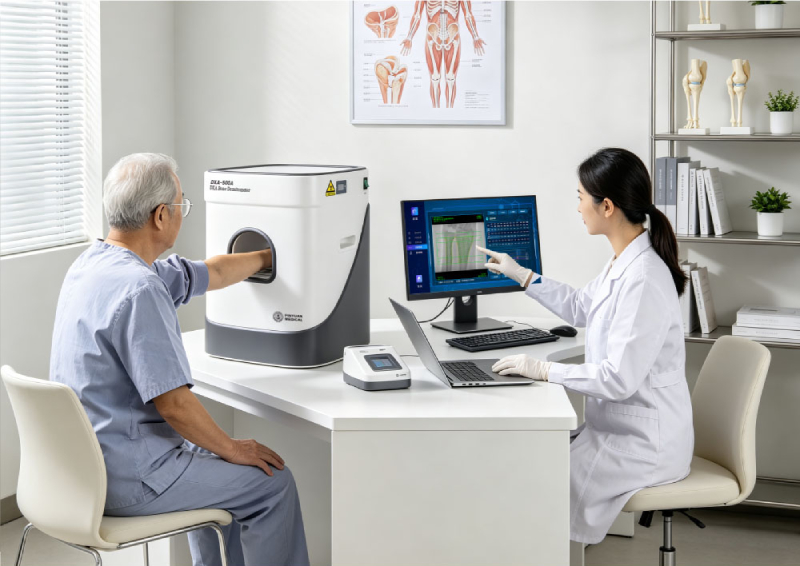
Xuzhou Medical University Affiliated Hospital (Grade A Tertiary Hospital). In March 2026, the DXA-500A bedside dual-energy X-ray bone densitometer was officially put into service in the Osteoporosis Department of Xuzhou Medical University Affiliated Hospital. With its advantages of ‘portability and precision’, the device overcomes the limitations of traditional large-scale bone density scanners, which must be fixed in radiology departments, rely on lead-lined rooms and are difficult to transport. Whether for bedridden critically ill patients, elderly patients with limited mobility, or patients requiring close monitoring of bone density following surgery, there is no need to move them with great effort to a testing room; professional-grade bone density testing can be carried out right at their bedside in the ward.
Jingjiang Traditional Chinese Medicine Hospital. On 17 March 2026, the DXA-500A was successfully installed, commissioned and fully accepted at Jingjiang Traditional Chinese Medicine Hospital, and officially put into clinical use. The device is equipped with a detection system and data processing module tailored to clinical settings, enabling it to rapidly and accurately collect bone-related data and automatically generate standardised, comprehensive test reports. The Pinyuan Medical technical team simultaneously conducted hands-on training for the hospital’s medical staff.
A specialist hospital in Hebei. On 20 January 2026, the DXA-500A was successfully installed and commissioned at a specialist hospital in Hebei. The equipment will effectively improve the early screening rate and diagnostic accuracy for bone health issues such as osteoporosis in the local area.
V. In which settings is the DXA-500A suitable?
Orthopaedic wards — Patients recovering from fractures or joint replacement surgery require regular monitoring of bone recovery; the device can be wheeled directly to the bedside to perform scans.
Geriatric wards — The progression of bone loss in the elderly requires careful monitoring; the device can rapidly screen high-risk individuals. With a prevalence of osteoporosis of 32 per cent among those aged 65 and over, regular bone density testing is particularly important for the elderly.
Rehabilitation Department — Patients recovering from fractures and those undergoing treatment for osteoporosis require regular monitoring of changes in bone density to adjust the intensity of rehabilitation training and treatment plans.
Endocrinology Department — The device can accurately assess changes in bone mass in postmenopausal women and those using hormone therapy.
Health Check-up Centres and Mobile Healthcare — The device’s 4-second rapid scanning capability effectively addresses the screening demands during peak health check-up periods. It can be flexibly deployed across various areas of health check-up centres or on mobile health check-up vehicles. During community charity clinics and health kiosk screenings, the device can be taken directly to the event venue, eliminating the need for patients to travel to and from the hospital.
Care Homes — Bedridden elderly residents experience accelerated bone loss; the device’s portability enables direct bedside testing.
From the Affiliated Hospital of Xuzhou Medical University to Jingjiang Traditional Chinese Medicine Hospital, from specialist hospitals in Hebei to a growing number of healthcare institutions currently implementing the technology—the DXA-500A is redefining the ‘bedside potential’ of bone density testing with its lightweight design (19.8 kg), rapid scanning in under 4 seconds, battery life of over 10 hours, and flexible deployment without the need for a lead-lined room.
Bringing the equipment to the patient, rather than making the patient travel to the equipment — the Pinyuan DXA-500A, designed specifically for bedside testing in hospital wards.
Post time: Jul-08-2026