

Throughout a child’s growth, height remains one of the topics of greatest concern to parents. Some children, despite being of similar chronological age, differ significantly in height; others may have been the tallest in their class during primary school, only to be gradually overtaken by their peers in secondary school. Behind these phenomena lies a key indicator: bone age.
Bone age is a method of assessing the biological age of children and adolescents by observing the degree of skeletal development. Compared with general physiological indicators such as height and weight, bone age provides a more accurate reflection of a child’s actual developmental status. The core of bone age assessment lies in the observation of a specific structure: the epiphyseal line.
I. The Epiphyseal Line: The ‘Switch’ for Height Growth
To understand bone age, one must first understand the epiphyseal line.
The epiphyseal line is the cartilaginous tissue located between the epiphysis and the shaft at either end of a long bone; it is also known as the growth plate. Before puberty, this cartilage divides actively, causing the bone to lengthen continuously—it is the key to height growth.
You can visualise it this way: a bone is like a building under construction. The epiphyseal lines at either end of the long bones are the‘construction crew’, constantly converting cartilage into bone, causing the bones to grow longer bit by bit. The younger a child is, the wider the gap in the epiphyseal line, indicating greater potential for growth; as they get older, the gap gradually narrows until it eventually closes completely.
Once the epiphyseal line has closed, a person’s height is essentially fixed.
On an X-ray, the epiphyseal line appears as a radiolucent band at either end of a long bone. When this band becomes blurred and eventually disappears, it means the epiphyseal line has closed. Generally speaking, by around 14 years of bone age for girls and 16 years for boys, the epiphyses are largely closed, and height growth ceases accordingly.
Growing taller is like a race against the closure of the epiphyseal line.
II. Bone Age: A ‘Growth Clock’ That Understands a Child Better Than Chronological Age
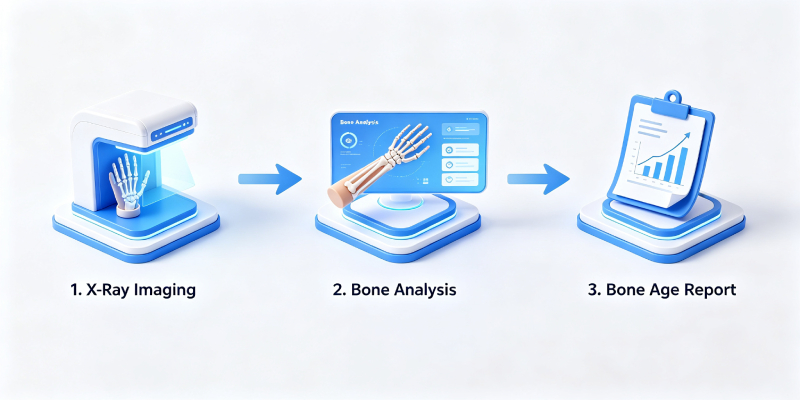
The condition of the epiphyseal lines cannot be observed with the naked eye, but bone age testing can clearly reveal it.
Bone age testing usually involves taking an X-ray of the left wrist. The wrist contains more than twenty bones—including metacarpals, phalanges and carpal bones—at different stages of growth, acting as a ‘progress display’ for skeletal development throughout the body. By observing the timing of the appearance of ossification centres in these bones, their morphology and the degree of epiphyseal closure, and comparing these with standard bone age charts, doctors can determine a child’s bone age.
Bone age provides a more accurate reflection of a child’s growth, development and maturity than chronological age.
Under normal circumstances, the difference between bone age and chronological age should not exceed ±1 year. If it falls outside this range, it may indicate a growth or developmental issue:
Advanced bone age (more than 1 year ahead of chronological age) — may be caused by factors such as precocious puberty or obesity. Premature secretion of sex hormones accelerates skeletal maturation, leading to early closure of the epiphyses and a shortened growth period. Data from a charitable paediatric clinic at Xuzhou First People’s Hospital shows that approximately 15 per cent of children have a bone age that is ≥1.5 years ahead of their chronological age.
Delayed bone age (more than 1 year behind chronological age)—may be associated with growth hormone deficiency, hypothyroidism, malnutrition and other conditions. In the aforementioned free clinic, children with a bone age lagging behind their chronological age by ≤1.5 years accounted for approximately 12 per cent.
III. Why is it important to monitor bone age?
To assess growth potential. Bone age is a key indicator for determining a child’s remaining growth potential. The younger the bone age, the greater the growth potential; the older the bone age, the less growth potential remains. Bone age provides a relatively accurate indication of a child’s remaining growth period and growth potential.
To aid in the diagnosis of diseases. Abnormal bone age may be a sign of certain endocrine disorders—conditions such as precocious puberty and hyperthyroidism can lead to advanced bone age, whilst growth hormone deficiency and hypothyroidism can lead to delayed bone age. Bone age testing enables the early detection of these issues.
Guiding clinical intervention. For children with conditions such as short stature or precocious puberty, bone age testing provides crucial guidance for formulating treatment plans and assessing treatment efficacy.
IV. Which children require bone age testing?
Not all children require bone age testing. The Shanghai Municipal Health Commission recommends that for children with normal development, bone age should be assessed every 1–2 years from the age of 3 onwards, as part of routine check-ups.
Particular attention should be paid to the following situations:
Significant height discrepancy: more than 10 centimetres shorter than peers of the same age
Abnormal growth rate: annual growth of less than 5 centimetres between the ages of 3 and puberty, or less than 6 centimetres per year during puberty
Overweight or obesity: obesity may affect bone age development
If the assessment reveals an abnormal bone age, follow-up examinations should be conducted every 3–6 months for dynamic monitoring.
V. Pinyuan BAD-Q Series Bone Age Analysers: Making Bone Age Assessment More Accurate and Safer
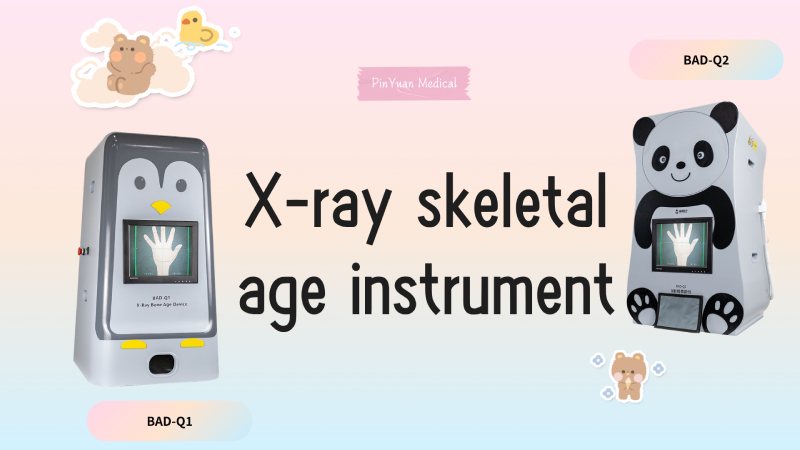
The scientific rigour and accuracy of bone age assessment rely heavily on the support of specialist equipment. The BAD-Q series X-ray bone age analysers from Pinyuan Medical provide a professional and reliable solution for paediatric bone age assessment.
High-definition imaging captures details of the epiphyseal lines with clarity. The BAD-Q series utilises CBCT (Cone Beam Computed Tomography) technology, equipped with a high-frequency, small-focus X-ray source and a fully digital flat-panel detector. It offers fast imaging speeds and high image clarity, enabling the clear visualisation of epiphyseal development details in the phalanges, metacarpals and carpal bones.
Multi-algorithm fusion ensures precise bone age assessment. The BAD-Q series integrates multiple internationally recognised bone age assessment algorithms, including the TW3 method and the Zhonghua 05 method. The TW3 method is an internationally recognised standard for bone age assessment, whilst the Zhonghua 05 method is the Chinese industry standard for bone age assessment, specifically developed to accurately assess the bone age of Chinese children. Through the fusion of multiple algorithms, potential errors arising from the use of a single algorithm are effectively minimised, making bone age assessment more precise and reliable.
Low-dose design for greater peace of mind during paediatric examinations. The BAD-Q series utilises low-dose, low-radiation imaging technology, with the surface radiation level during a single examination being virtually identical to natural background radiation levels. The entire unit features a fully enclosed lead-shielded structure, complemented by dedicated lead curtains, allowing it to be deployed in standard consultation rooms without the need for a specialised lead-lined room. The remote operation design enables operators to complete the entire procedure from a safe distance.
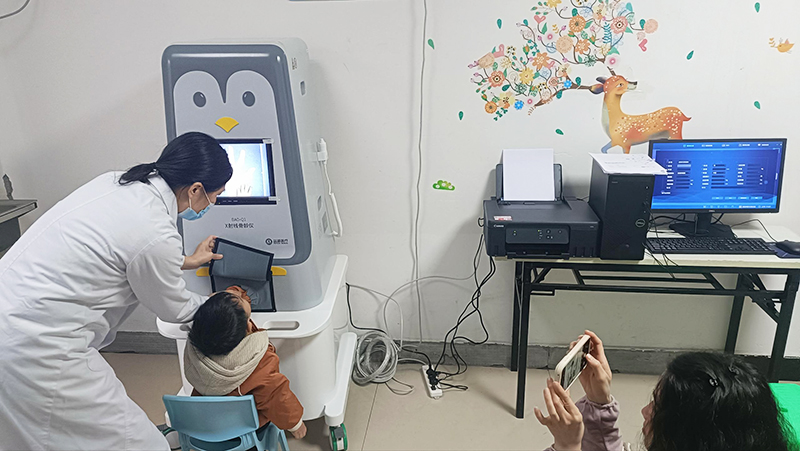
Child-friendly design to alleviate anxiety during examinations. The BAD-Q1 features a cartoon penguin design, whilst the BAD-Q2 features a cartoon panda design. This cute and reassuring design effectively alleviates children’s anxiety during examinations. The equipment is equipped with a three-point positioning system—including hand positioning guides, real-time monitoring via the control screen, and software-assisted video guidance—enabling medical staff to operate it proficiently after only a short training period.
Widespread implementation and clinical validation. The BAD-Q series has been put into use at numerous medical institutions across the country—Daqing People’s Hospital (Grade III, Class A) completed the installation of the BAD-Q1 in November 2025; Chengdu Sport University successfully installed the BAD-Q1 in September 2025; and Luxian Maternal and Child Health Hospital has standardised bone age testing following the introduction of the BAD-Q1.
The epiphyseal line acts as the ‘switch’ for height growth, whilst bone age is the key to understanding this ‘switch’. Bone age assessment provides a relatively accurate reflection of an individual’s growth and development level and degree of maturity, and is of great significance in predicting adult height and identifying growth and developmental abnormalities.
Tracking growth through the epiphyseal line – bone age assessment ensures that every child’s growth is ‘clearly understood’.
Post time: Jul-27-2026