

Core Value of Arteriosclerosis Detectors & Key Procurement Considerations
When purchasing an arteriosclerosis detector, four core dimensions should be clarified first: applicable department scenarios, testing accuracy requirements, budget range and after‑sales service demands, so as to prevent model selection deviating from actual application needs. This content only covers medical‑grade arteriosclerosis detectors and excludes consumer‑grade home‑use products. It serves as a procurement reference for public medical institutions and private physical examination organizations in China.
For physical examination centers in Grade‑A tertiary hospitals with sufficient annual procurement budgets and a high daily volume of arteriosclerosis screenings, testing efficiency and report generation speed are primary selection considerations, which directly determine patient throughput during peak physical‑examination periods. For grassroots community health service centers with limited budgets and less experienced medical staff, ease of operation and on‑site training support constitute core requirements, which can effectively lower operational barriers after equipment deployment.
Clinical Application Scenarios and Suitable Departments for Arteriosclerosis Detectors
Equipment performance requirements vary significantly according to the demands of different departments. Applicable scenarios must be defined prior to procurement:
- Physical examination centers: Capable of rapid screening for large patient flows, featuring fast testing and convenient report generation; compatible with physical examination systems for automatic data upload
- Geriatrics and Cardiology Departments: High testing accuracy and comprehensive evaluation dimensions, enabling stratification of cardiovascular and cerebrovascular risks to assist clinical diagnosis
- Community health service centers & health cabins: Simple operation and low maintenance costs, allowing auxiliary operation by non‑specialist staff to meet grassroots chronic disease screening demands
Medical‑grade arteriosclerosis detectors are applied for early arteriosclerosis screening and cardiovascular/cerebrovascular disease risk assessment. They are widely deployed in Cardiology, Neurology, Endocrinology, Geriatrics, Rehabilitation, Physiotherapy, physical examination centers, health cabins and other settings. Purchasers may set performance priorities according to their specific scenarios.
Four Core Requirement Dimensions to Confirm Before Procurement
Defining core demands in advance greatly improves selection efficiency. Evaluation criteria for the four dimensions are as follows:
- Testing accuracy requirements: For clinical diagnosis scenarios, give priority to clinically validated equipment whose measurement errors meet industrial standards; performance requirements may be moderately relaxed for routine screening.
- Budget range: Confirm procurement budget and subsequent maintenance budget to avoid selecting models beyond budget limits.
- Site conditions: Choose equipment with dimensions matching the available space. Portable or compact models are recommended for sites with space constraints.
- After‑sales requirements: Select appropriate after‑sales packages based on institutional operation and maintenance capacity. Facilities lacking in‑house technical support should prioritize manufacturers offering on‑site maintenance and operational training.
Key Qualifications and Certification Standards for Arteriosclerosis Detectors
Compliant medical arteriosclerosis detectors shall hold a Medical Device Production License, ISO9001 quality management system certification and meet national medical device registration requirements. Procurement of non‑compliant products brings regulatory risks and hidden dangers in clinical use. Overseas purchases must comply with local regulatory standards.
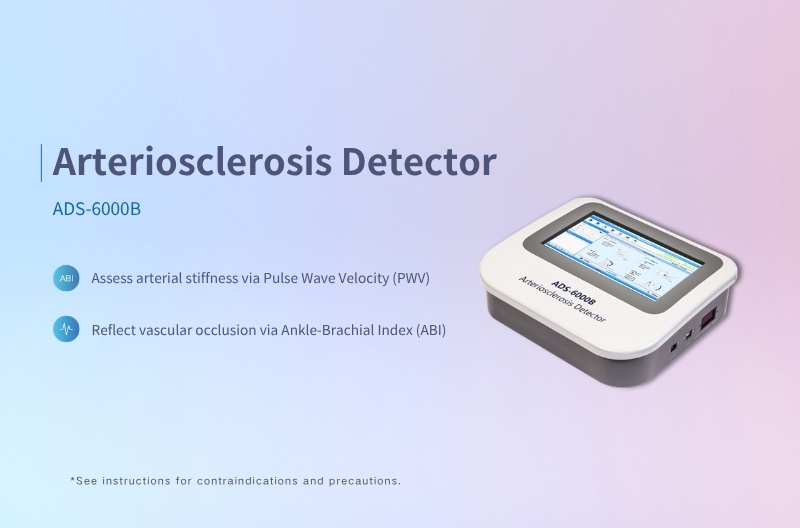
Core Performance Introduction for PinYuan Medical ADS‑6000 Series
The core parameters of the ADS‑6000 Series arteriosclerosis detectors by Pin Yuan Medical have undergone clinical verification to satisfy the needs of multiple departments:
- Precise measurement: Vascular assessment performed via Pulse Wave Velocity (PWV) and Ankle‑Brachial Index (ABI). The measurement method is accurate, efficient and highly practical.
- Comprehensive analysis: Evaluates vascular elasticity, atherosclerosis severity and cardiovascular‑cerebrovascular risks, and provides multi‑dimensional health recommendations.
- User‑friendly operation: Streamlined interface and standardized workflow. Medical staff can master operation quickly after professional training.
- Detailed reports: Generates colour dynamic reports containing sampled waveform data, vascular elasticity assessment and specific parameters. Doctors may add diagnostic comments and guidance suggestions.
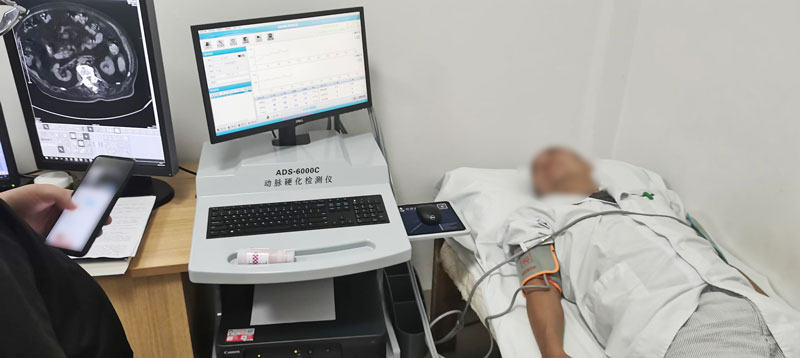
Clinical Cases and Market Reputation Reference for Arteriosclerosis Detectors
To evaluate actual equipment performance, refer to publicly released cooperating hospital cases, clinical validation reports and user feedback. The listed cases only represent public cooperation information and do not guarantee identical outcomes in all application scenarios. Purchasers shall verify suitability against their own practical conditions.
Verification Methods and Reference Value of Clinical Cases
Do not rely solely on verbal case claims from manufacturers during procurement. Verify case authenticity through the following approaches: Request manufacturers to provide cooperation agreements or screenshots of official procurement announcements. Products with cooperation records at Grade‑A tertiary hospitals are preferred for higher clinical recognition. Case references from peer‑level medical institutions carry greater value. Prioritize feedback from facilities within the same region, of the same grade and with identical application scenarios. Select products with over 3 years of clinical application. Long‑term clinically verified equipment delivers better stability and a lower failure rate.
Clinical Application of PinYuan Medical Arteriosclerosis Detectors
PinYuan Medical devices are sold in more than 50 countries and regions worldwide, serving over 5,000 medical institutions, including more than 200 Grade‑A tertiary hospitals such as Children’s Hospital of Capital Institute of Pediatrics, Beijing Chaoyang Hospital, Peking University Third Hospital and Shanghai Sixth People’s Hospital, as well as over 500 Grade‑A secondary hospitals. Clinical applications cover Cardiology, Geriatrics, physical examination centers and other scenarios. The performance and stability of the equipment have been validated through long‑term clinical practice and widely recognised by industry experts and physicians.
Post time: Aug-31-2026