
The working principle of an ultrasound bone densitometer is to calculate bone mineral density by measuring the speed of ultrasound waves as they pass through the bone being examined. It serves as a radiation-free, portable tool for bone health screening.
The specific operational process is as follows:
The ultrasound probe equipped with the bone densitometer is typically placed on the examinee’s tibia or radius. As the ultrasound waves pass through the bone, they interact with its mineral content and microstructure. It is important to note that before the probe contacts the skin, a layer of medical ultrasound coupling gel (a water-based gel) must be applied either to the examination site or onto the probe.
This is necessary because the skin surface has microscopic irregularities and contains air. Air acts as an “insulator” for ultrasound waves, causing over 99% of the ultrasonic energy to be reflected and preventing it from entering the body. The coupling gel completely fills the air gaps between the probe and the skin. Its acoustic properties fall between those of the probe and soft tissue, enabling efficient acoustic impedance matching. This allows the ultrasonic energy to penetrate the skin and transmit into the body.
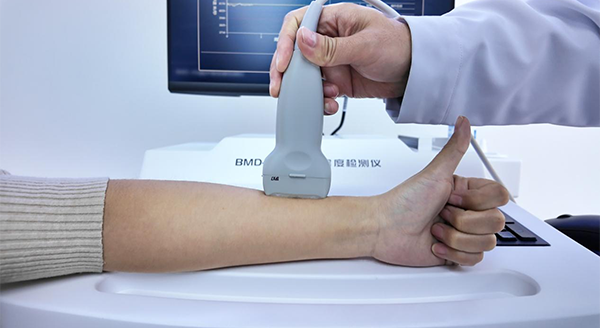
This process generates two key physical effects:
Speed of Sound (SOS): The propagation speed of ultrasound waves within the bone. The higher the mineral density and the more compact the structure of the bone, the faster the sound waves travel. Therefore, SOS primarily reflects the density and elasticity of the bone.
Broadband Ultrasound Attenuation (BUA): The attenuation, or reduction in energy, of ultrasound waves as they pass through the bone, caused by absorption and scattering. The more complex and intact the internal bone structure, the stronger its scattering and absorption characteristics, leading to greater attenuation. Therefore, BUA primarily reflects the microstructural properties and elasticity of the bone.
Parameter Integration and Assessment:
The ultrasound bone densitometer combines these two parameters, SOS and BUA, using specific algorithms to calculate a comprehensive assessment index. This index is then compared against reference values stored in the device’s built-in database, which is based on healthy populations of the same ethnicity, gender, and age. The comparison yields an assessment result expressed as a T-score (comparison with the peak bone mass of young adults) and a Z-score (comparison with an age- and gender-matched reference group), along with an evaluation of fracture risk.
Ultrasound bone densitometers are suitable for large-scale community screening, initial health check-up screenings, bone health monitoring for special populations such as pregnant women and children, and preliminary osteoporosis risk assessment in primary healthcare settings. They are easy to operate, low-cost, portable, and represent an excellent screening tool. With advantages including safety, speed, absence of radiation, and low cost, they are particularly well-suited for the initial screening of osteoporosis risk and population-wide surveys.
Post time: Jan-08-2026