
In clinical scenarios such as the assessment of children’s growth and development and the diagnosis of endocrine diseases, X-ray bone age meters are key equipment. The test results directly affect the formulation of the diagnosis and treatment plan, so a scientific evaluation system needs to be established when purchasing equipment. In combination with clinical needs and industry norms, the selection of X-ray bone age instruments should follow the core principle of “qualification certification > accuracy > safety > convenience > price” to ensure that the equipment not only complies with medical standards but also meets the actual diagnosis and treatment needs.
Qualification certification: The bottom line for the entry of medical equipment
Qualification certification is the “key” for X-ray bone age instruments to enter the medical field and also an important prerequisite for avoiding medical risks. As a Class II medical device, its production and operation are subject to strict regulatory constraints. Even if the performance parameters of the equipment are excellent, it cannot guarantee the legality and reliability of clinical application without compliance qualifications.
When making a purchase, it is necessary to focus on verifying two types of core qualifications: For manufacturing enterprises, it is necessary to confirm that they hold a valid “Medical Device Production License” to ensure that the equipment production process complies with quality management norms; In addition, the equipment itself must have the “Medical Device Registration Certificate” issued by the National Medical Products Administration. Meanwhile, the bone age assessment system of the equipment should be compatible with commonly used clinical standards, such as the Chinese 05 Method and the TW3 method, to ensure the reliability of the assessment basis.
Accuracy: A key support for diagnosis and treatment decisions
The core significance of bone age testing lies in accurately reflecting an individual’s growth maturity through the development degree of the ossification center in the wrist. The results are directly related to the diagnosis and treatment plan formulation of diseases such as precocious puberty and growth hormone deficiency. Clinical data shows that the difference between bone age and actual age needs to be controlled within a certain range. Devices with insufficient accuracy may lead to misjudgment of bone age, which in turn may cause treatment delays or excessive medical treatment.
The accuracy of the assessment equipment can be approached from two aspects: The key to ensuring that the equipment maintains stable assessment accuracy at different age groups and in different growth and development states is, first, the quality of image acquisition. The equipment needs to have high-resolution imaging capabilities to clearly present the detailed features of the fine ossified structures in the wrist, providing a clear basis for subsequent assessment. The second is to assess the reliability of the system. An automatic assessment system can effectively reduce human judgment errors.
Safety: The fundamental guarantee for the protection of both doctors and patients
The radiation characteristics of X-ray bone age meters determine that safety is a rigid requirement for equipment selection. Especially for children, who are the main subjects of detection, their body tissues are more sensitive to radiation, and multiple protective designs must be adopted to reduce radiation risks. The safety assessment of equipment should cover two dimensions: radiation control and operational protection.
In terms of radiation control, the radiation dose of the equipment must strictly comply with the national radiation safety standards for medical X-ray equipment. Products that adopt low-dose imaging technology should be given priority to ensure image quality while reducing radiation exposure. In terms of operation protection, the equipment should be equipped with complete protective devices, such as lead shielding enclosures and protective lead curtains. In addition, to address the issue of unstable body position that may occur during children’s tests, the equipment should have rapid imaging capabilities, shorten the exposure time, and further reduce the risk of radiation accumulation. The reasonable distance design between the operation area and the testing area for medical staff is also an important consideration for ensuring the safety of medical staff.
Convenience: A boost for enhancing the efficiency of diagnosis and treatment
On the basis of ensuring qualifications, accuracy and safety, the convenience of the equipment directly affects the efficiency of clinical work. Especially in scenarios with high demand for testing such as pediatric outpatient clinics, a convenient operation process can effectively shorten the waiting time for patients. Convenience is mainly reflected in three aspects: operation process, equipment compatibility and data management.
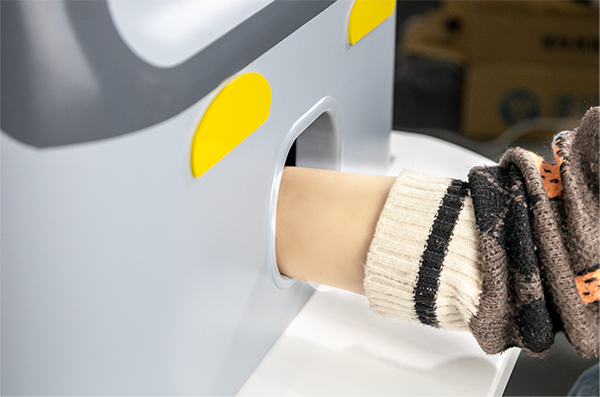
At the operational level, the equipment should have a simple interactive interface and clear operation instructions to facilitate medical staff in quickly mastering the usage methods and reducing training costs. For child patients, the equipment can be designed with a detection position assistance device that conforms to their physiological characteristics, reducing the difficulty of position placement. In terms of adaptability, the volume of the equipment should match the treatment space, and at the same time, it should have flexible installation and mobility capabilities to meet the usage requirements of different departments. In terms of data management, the equipment should support the rapid storage, query and export functions of detection images and reports, and be able to connect with the hospital information system to achieve data interconnection and interoperability, reducing manual entry errors.
Price: The final factor to be comprehensively considered
A reasonable price assessment should be based on “cost performance” : on the one hand, it is necessary to combine the key performance parameters of the equipment and compare whether the quotations of different manufacturers match the equipment configuration; On the other hand, the long-term usage cost should be fully considered. At the same time, the after-sales service capabilities of manufacturers should also be taken into account in terms of price considerations, such as whether they provide timely technical support and software updates. These factors directly affect the service life and user experience of the equipment. Ultimately, products that conform to the budget plan should be selected under the premise of meeting clinical needs.
The selection of an X-ray bone age instrument is essentially a balancing process between medical quality and diagnostic and therapeutic needs. Only by adhering to the principle of “qualification first, precision foremost, safety as the foundation, convenience as an aid, and price matching” can we select equipment that truly meets clinical needs, providing reliable support for the assessment of children’s growth and development and the diagnosis and treatment of related diseases, and avoid falling into the purchasing trap of “emphasizing price over key points”.
Post time: Dec-03-2025