
Vascular health is an important cornerstone of overall health. Early changes in vascular function are often subtle indications of cardiovascular and cerebrovascular risk signals. Especially in recent years, with the acceleration of the social pace, poor dietary and living habits have given rise to an increasing number of sub-healthy groups. Against this backdrop, how to assess arterial stiffness through objective and convenient means has become an urgent issue to be emphasized in the fields of health management and clinical prevention.
Arteriosclerosis is not exclusive to aging but a progressive pathological process. This change will directly cause two major problems: First, the decrease in vascular elasticity leads to an increase in systolic blood pressure and an increase in pulse pressure difference, thereby increasing the burden on the heart; Second, the rough walls of blood vessels are prone to adsorbing lipids to form atherosclerotic plaques. If these plaques fall off, they may clog the blood vessels, leading to more serious health problems.
Working principle: Multi-dimensional data, comprehensive assessment
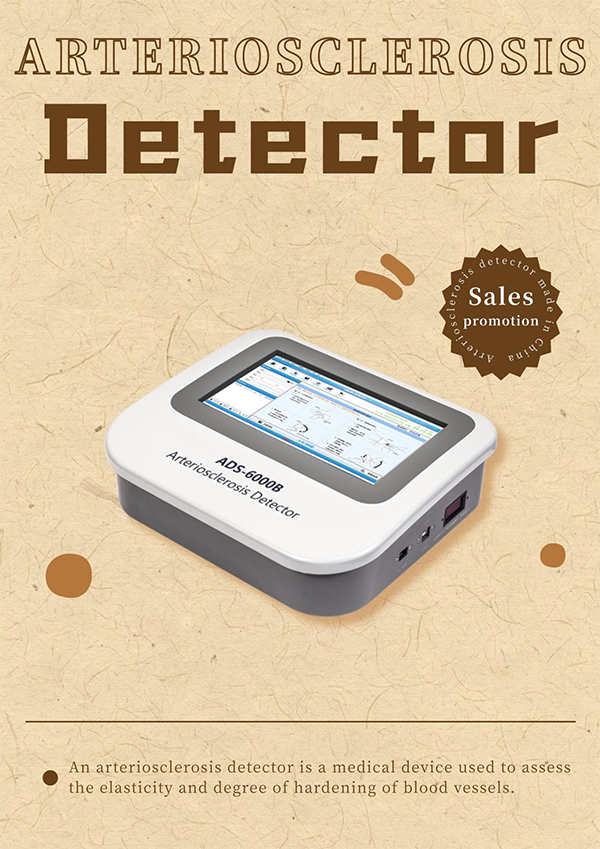
The core value of the arteriosclerosis detector lies in converting the “hidden lesions” of blood vessels into quantifiable scientific data. The ADS-6000B arteriosclerosis detector from Pinyuan Medical measures non-invasive blood pressure in the limbs by synchronous compression, and simultaneously records and analyzes the pulse waveforms of the arteries in the limbs in real time. It uses waveform analysis technology to extract characteristic information characterizing vascular elasticity and calculate multiple indicators including ankle-brachial index (ABI) and brachial-ankle artery pulse wave velocity (baPWV). Through automatic analysis and comprehensive assessment of database data, the health status of the cardiovascular system and the degree of lower extremity arterial obstruction are evaluated, providing a comprehensive and objective basis for the early diagnosis of arteriosclerosis and the early screening of cardiovascular and cerebrovascular diseases. The entire process is non-invasive, fast and offers a comfortable experience, making it suitable for a wide range of health screening and assessment scenarios.
Institutional upgrade: Improve the evaluation system and enhance service capabilities
For medical institutions, physical examination centers and health management institutions, introducing professional arteriosclerosis detection equipment is by no means simply adding a test item, but rather achieving a systematic upgrade of health service capabilities. Its value is reflected in four dimensions:
Early risk identification: Through quantitative data, accurately identify the potential risks of asymptomatic individuals, providing objective detection basis for the early prevention and management of cardiovascular and cerebrovascular diseases, and shifting from “passive treatment” to “active prevention”.
Enrich assessment items: Incorporate vascular function assessment into existing health check-up or physical examination packages to meet the public’s demand for precise health management and enhance the professionalism and comprehensiveness of services.
Data-driven management: Clear reporting and data tracking functions help establish personal vascular health records, enabling long-term dynamic observation and providing a scientific basis for doctors to formulate personalized intervention plans such as dietary adjustments and exercise guidance.
The operation process is highly efficient: The equipment design emphasizes humanization, is easy to operate, and enables rapid detection. It can easily handle the flow pressure during peak physical examination periods, balancing professionalism and operational efficiency.
Purchase Guide: Focus on five aspects to Select Reliable Equipment
When choosing a suitable arteriosclerosis detector, it is necessary to base on the service scenarios and long-term development needs of the institution. It is recommended that institutional users make a comprehensive consideration from the following five aspects:
The stability of measurement performance: Ensuring the accuracy, reliability and repeatability of data is the foundation for evaluating value.
The convenience of operation: Whether the process is simple and the human-computer interaction is friendly directly affects the detection efficiency and personnel training cost.
The clarity and professionalism of the report: The generated assessment report should be intuitive and easy to understand, while also including necessary professional parameters and analyses, facilitating interpretation and communication.
System integration and scalability: Whether the equipment supports data export and can be well integrated with the existing health management system or hospital information system.
Professional support from the manufacturer: Whether it provides comprehensive operation training, technical support and after-sales service.
Vascular health management not only safeguards the quality of life of individuals but also demonstrates the fulfillment of health service responsibilities by institutions. The ADS-6000 series arteriosclerosis detector from Pinyuan Medical is developed based on the concept of “precise detection, convenient service, and long-term protection”. From stable measurement performance to clear assessment reports, from efficient operation design to comprehensive service support, it fully meets the clinical and health management needs of institutions. Choosing reliable testing equipment means choosing to walk hand in hand with the health of the examinees, jointly building a solid defense line against cardiovascular and cerebrovascular diseases, and contributing solid strength to improving the vascular health management level of the entire population.
Post time: Dec-18-2025