
In the procurement of medical equipment, “Which is better, a portable bone density meter or a desktop one?” is a frequent confusion for many medical institutions, physical examination centers, and even grassroots community health service centers – both are for measuring bone density, so why can some devices be carried around while others need to be installed fixately? Choosing the right one can improve the efficiency of diagnosis and treatment, while choosing the wrong one may waste costs and be impractical. The selection of bone density meters should be based on technical characteristics and clinical needs. The following is a detailed analysis from four major categories.
Portable ultrasonic bone densitometers are the “light cavalry” of bone health screening. Take the BMD-A3 from Pinyuan Medical as an example. Its lightweight design of 4.3 kilograms makes it easy to carry. It uses radial or tibial detection technology, has no ionizing radiation, and can complete the processes of information entry, detection, and report issuance within 60 seconds. It is particularly suitable for mobile scenarios such as community free clinics and rural screening. This type of equipment has a low operating threshold and does not require a professional protective site. It can quickly complete the initial screening of the elderly population. When used as a diversion tool in a physical examination center, it can significantly improve the overall testing efficiency.
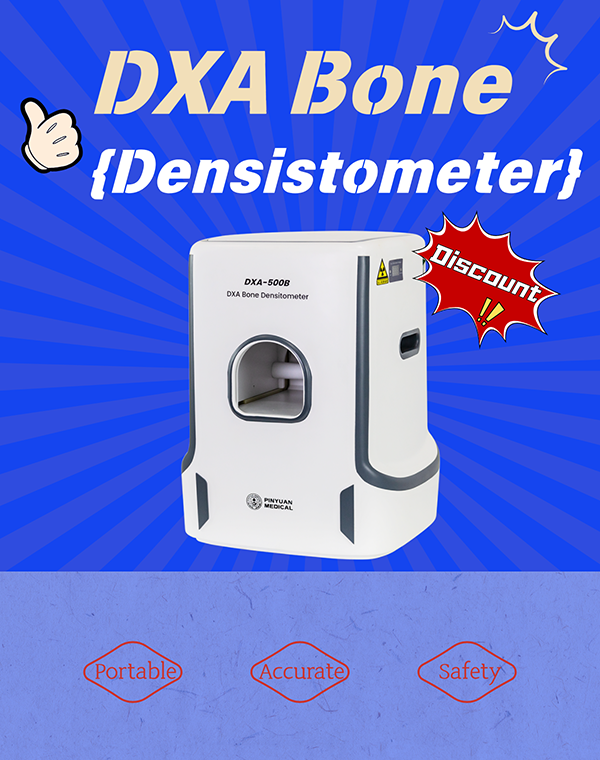
The portable dual-energy X-ray bone densitometer fills the gap in mobile diagnosis. The DXA-500 series of Pinyuan Medical breaks the traditional perception. With a body weighing 19.8 kilograms, it can be moved by a single person. The lead-free room design is suitable for various scenarios. It adopts the dual-energy X-ray gold standard technology, with a 4-second rapid scanning and a triple positioning guarantee system, ensuring high data accuracy. The wireless mode supports the use of medical vehicles and remote health centers, allowing precise diagnosis to no longer be restricted by the site. Meanwhile, the low-radiation design comprehensively safeguards the safety of both medical staff and patients.
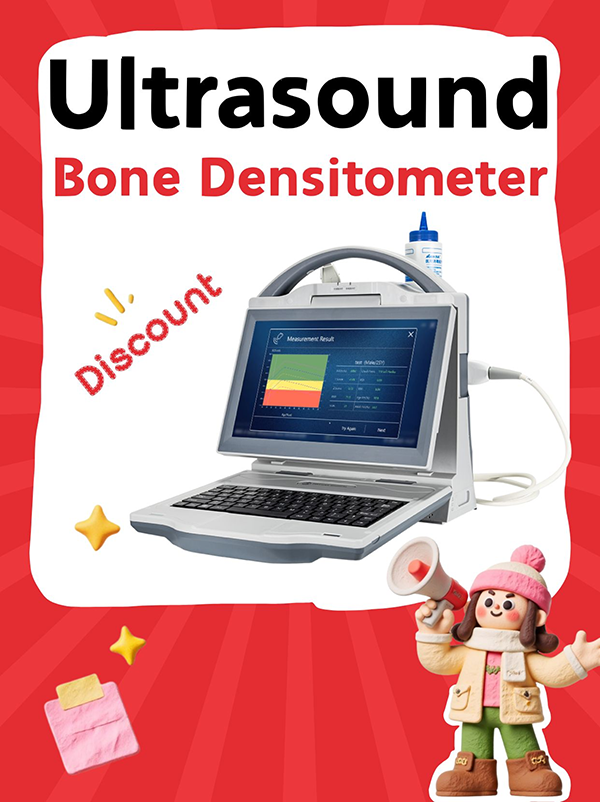
The benchtop ultrasound bone densitometer is a “stabilizer” for clinical assessment. Although the BMD-A7 ultrasound image bone densitometer from Pinyuan Medical is larger in size than the portable model, it has a more precise internal structure and better measurement stability and repeatability. It is equipped with a dedicated database for Chinese people, supports multi-part detection, and can be seamlessly integrated with the patient management system. It is mainly deployed in the orthopedics and endocrinology outpatient departments of hospitals, providing reliable data for bone density assessment and therapeutic effect monitoring. It is particularly suitable for precise detection of special groups such as obese patients.
The desktop dual-energy X-ray bone densitometer is the “gold standard equipment” for diagnosis. The DXA-800E from Pinyuan Medical is equipped with a dynamic digital flat panel detector, which can precisely measure multiple key sites at the distal radius and integrates a dual assessment system for bone density and bone age. It supports multiple modules such as FRAX® fracture risk assessment, providing a comprehensive basis for monitoring children’s growth and development and diagnosing osteoporosis in adults. The remote operation and local shielding design not only meet the clinical needs of tertiary hospitals but also comply with radiation protection standards.
The four types of equipment are not in a substitutive relationship but rather complementary and compatible. For grassroots institutions that focus on screening, portable ultrasound can be chosen; for those that require mobile diagnosis, portable DXA should be selected. For clinical diagnosis in hospitals, desktop DXA is preferred, and for specialized assessment, desktop ultrasound can be used in combination. To truly realize the value of bone density meters, it is necessary to clarify the service positioning – whether it is to expand the coverage of screening or improve the diagnostic accuracy.
Post time: Dec-18-2025