

Among numerous assessment indicators for the growth and development of children and adolescents, bone age serves as an important reference for interpreting growth potential. It can be used to evaluate skeletal maturity, and relevant assessment results provide supporting references for height management, screening of developmental abnormalities, selection of sports talents and other work. With the rising public health awareness, incorporating bone age testing into annual physical examinations for children and adolescents has become a consensus among a growing number of medical institutions and parents. However, when procurement departments or department heads plan to introduce bone age detectors for routine physical examinations, they face devices with different technical routes and functional configurations on the market. How to conduct scientific model selection to ensure the equipment meets the high-frequency and high-efficiency demands of physical examination services while satisfying requirements for radiation protection and imaging performance is a professional issue requiring prudent consideration.
Starting from the practical demands of routine physical examination scenarios, this paper systematically sorts out key points for bone age detector selection, and objectively summarizes the technical characteristics and product layout of major domestic service providers, so as to offer professional references for procurement decisions of relevant institutions.
Core Value of Bone Age Testing in Physical Examination Scenarios
Nowadays, parents pay increasing attention to their children’s height development, and centralized physical examinations at schools and communities are gradually including bone age testing as a basic item. Bone age testing can objectively reflect a child’s biological age. Compared with chronological age, it provides references for assessing children’s growth potential and predicting adult final height. It can also act as reference material for preliminary screening of endocrine disorders such as precocious puberty and growth hormone deficiency. For medical institutions, equipping a bone age detector suitable for physical examination scenarios enables more in-depth and personalized health assessment services for examinees, helping improve institutional service reputation and medical experience.
Core Points for Bone Age Detector Selection
For routine physical examination scenarios, equipment selection requires comprehensive consideration of multiple dimensions including detection efficiency, radiation protection standards, imaging performance, operation convenience and site adaptability.
1. Radiation Safety and Protection Design
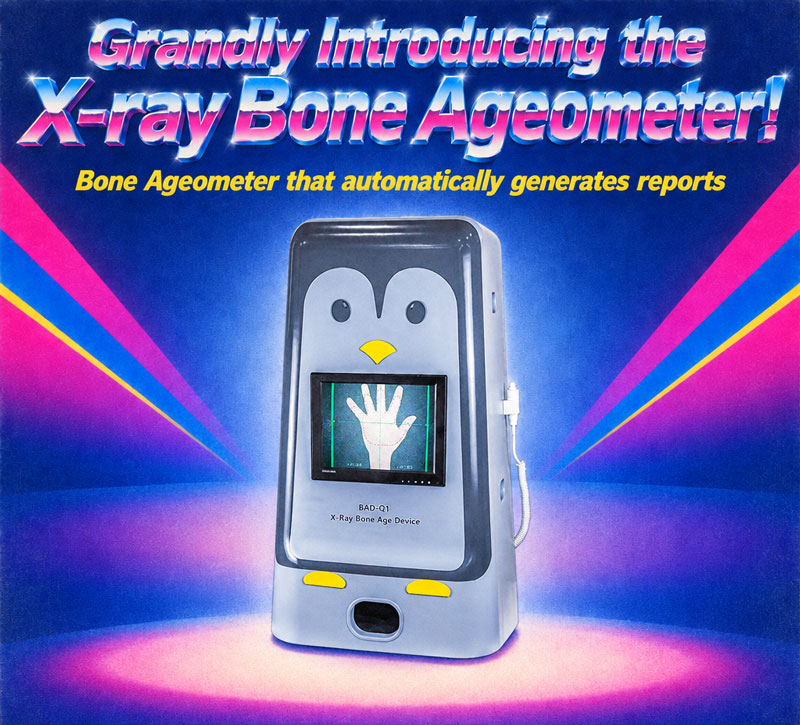
Children are more sensitive to radiation than adults, so radiation protection is the primary consideration in model selection. Clinically applicable equipment shall feature low-dose imaging capability to minimize radiation exposure of examinees while guaranteeing image quality. In addition, the protective structure of the equipment is critical. Devices adopting an integral fully enclosed lead shielding structure equipped with dedicated protective lead curtains help reduce the risk of ray leakage. Equipment with such design generally does not require a dedicated lead room and can be directly deployed in ordinary consulting rooms, lowering site renovation costs and space investment for institutions. For example, the BAD-Q1 X-ray bone age detector developed by PinYuan Medical adopts a fully enclosed lead shielding design, requiring no additional lead room construction and suitable for direct installation in ordinary consulting rooms. Equipped with a highly sensitive detector, it can complete imaging at a low radiation dose. The surface radiation value after a single test is close to the natural environmental background reference range, making it suitable for repeated monitoring of children.
2. Imaging Technology and Assessment Standards
Imaging performance lays an important foundation for bone age testing. The imaging technology adopted by the equipment directly determines image resolution and fine detail presentation capability. Most mainstream X-ray bone age detectors currently adopt cone-beam planar imaging technology, which can acquire hand skeletal information from multiple angles and all directions, clearly presenting subtle changes in morphology, size and density of epiphyses of phalanges, metacarpals and carpal bones. In terms of assessment algorithms, the equipment shall be embedded with at least one widely recognized domestic bone age assessment standard. At present, the TW3 and China-05 standards are commonly adopted in hospitals and research institutions. If the device can automatically identify ossification centers, calculate bone age and predict relevant growth potential, it helps reduce subjective bias caused by manual film reading and improve the efficiency of clinical assessment. PinYuan Medical’s bone age detectors integrate multiple assessment standards including TW3 and China-05. Combined with its high-definition imaging technology, they provide professional data references for bone age interpretation at the algorithm level.
3. Equipment Type and Operation Efficiency
Routine physical examination scenarios usually have a large patient flow, so equipment operation efficiency is crucial. In terms of equipment types, they are mainly divided into traditional X-ray equipment plus manual film reading systems and dedicated integrated bone age detectors. The former requires manual positioning and calibration. After shooting, manual interpretation or third-party software is needed for film reading, featuring cumbersome workflows, long single-case testing time, and results susceptible to the operator’s experience. In contrast, dedicated integrated bone age detectors such as PinYuan Medical’s BAD-Q1 streamline operation steps effectively by optimizing the whole workflow logic. Equipped with a three-positioning system consisting of hand limit diagrams, dual monitoring display windows and software video monitoring, it assists medical staff in completing standardized positioning, reduces repeated shooting, and shortens single-case testing time to the minute level. This design helps boost the department’s patient reception capacity and lower the operation threshold; medical staff can carry out screening after short-term training.
4. Software Functions and Report Generation
Another key demand in physical examination scenarios is the professionalism and readability of generated reports. High-performance bone age detectors shall automatically generate different versions of reports based on test data. For instance, concise reports can be used to quickly inform parents or examinees of results verbally; detailed reports contain comprehensive bone age data and growth potential predictions. Combined with the child’s age, height and weight, they also provide intervention references for nutrition matching, exercise selection, sleep management and other dimensions. Report content is for medical personnel’s reference only and cannot replace clinical diagnosis and treatment suggestions directly. After testing, PinYuan Medical’s bone age detectors can quickly generate two report modes: concise version and detailed version. The concise version facilitates rapid screening and assessment, while the detailed version supports in-depth diagnosis and analysis, meeting diversified demands of daily diagnosis and large-scale physical examination scenarios.
5. Regulatory Qualifications and After-sales Service
As medical devices, bone age detectors must obtain the Medical Device Registration Certificate, which is the basis for legal sales and use. During model selection, purchasers shall verify whether the equipment holds complete registration certificates and production licenses. Besides, the stability of the equipment’s after-sales service network, fault response speed and spare parts supply capacity also need to be evaluated. Choosing manufacturers with profound industry experience and favorable service reputation can support long-term stable operation of the equipment. As a high-tech enterprise in Jiangsu Province and the drafting unit of the national industry standard for dual-energy X-ray bone densitometers, PinYuan Medical has deep expertise in skeletal health. Its products have passed strict approval to ensure compliance.
PinYuan Medical focuses on medical devices for children’s growth and development. Its BAD-Q series X-ray bone age detectors stand out in protection design and detection efficiency. Adopting a cartoon penguin appearance, the product has strong design affinity, helping ease children’s anxiety during testing. Its core strengths lie in the integrated protection system of “low-dose imaging + fully enclosed shielding”, multi-algorithm fast imaging assessment system, and convenient deployment without a lead room. It is well-adapted to diverse scenarios including medical care, sports talent selection and primary-level physical examinations. As an equipment manufacturer mastering core technologies, PinYuan Medical provides comprehensive skeletal detection solutions tailored for physical examination scenarios.
Process Optimization and Experience Management
After equipment delivery, efficient application requires supporting workflows. In physical examination scenarios, bone age testing can be arranged as an independent module at the end of the physical examination process to avoid anxiety caused by long queues for parents and children. Meanwhile, institutions shall train dedicated personnel for bone age testing positioning, exposure and report interpretation, and establish standard operating procedures (SOP). Manufacturers like PinYuan Medical usually provide on-site training and operation guidance for medical staff upon equipment delivery to help operators get proficient quickly. Hardware equipment serves as an important carrier for building a standardized and normalized screening service system.
Procuring a bone age detector for routine physical examination scenarios is a systematic project requiring comprehensive consideration of technology, radiation protection, efficiency and cost. The core of model selection is to balance the development of skeletal assessment services and efficient department operation, with priority given to protection conditions for child examinees. As a professional bone age detector brand in the industry, PinYuan Medical offers optional equipment for medical institutions with comprehensive advantages in radiation protection, imaging performance, operation convenience and child-friendly design. It is recommended that purchasers select products matching business development needs after clarifying their physical examination volume, budget range and service positioning, so as to provide scientific and quantifiable assessment references for children’s growth and health.
The viewpoints in this paper are for reference only and shall not serve as the basis for consumption or investment decisions.
Post time: Sep-18-2026