
In the field of bone health assessment, ultrasonic bone density detectors have become important equipment in hospitals, physical examination centers and primary medical institutions due to their advantages of being non-invasive, safe and relatively easy to operate. The test results are directly related to the early screening of osteoporosis and the formulation of treatment plans. Regular calibration, as a crucial step for the accuracy of test data, not only affects the working efficiency of medical institutions but is also closely related to the accuracy of patients’ health tests.
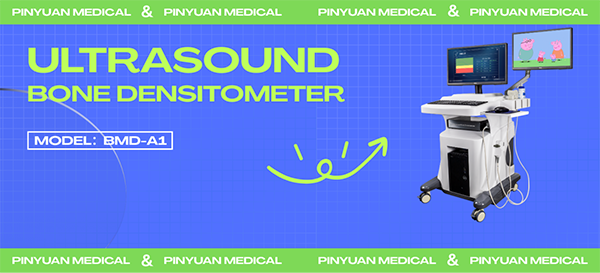
The Pinyuan Medical ultrasonic bone densitometer combines industry calibration standards with the actual operation logic of the equipment. Its calibration system not only complies with metrological standards but also takes into account the practical needs of clinical operations.
Calibration process: Clear and standardized, practical and controllable
Calibration operations must meet the basic environmental requirements. The steps focus on the detection scenarios of the radius/tibia, as detailed below:
Preparations before calibration
Environmental control: The temperature should be stabilized at 15 to 35℃, and the relative humidity at 30% to 85%. Strong electromagnetic interference (such as large medical equipment) or mechanical vibration should be avoided near the equipment.
Equipment and mold inspection: Confirm that the detection probe has no scratches or wear, and the detection surface is clean. Place the calibration module and the instrument in the same environment to ensure that their temperatures are consistent, avoiding excessive temperature differences that may cause deviations in sound velocity measurement.
Operation steps
Coupling preparation: Evenly apply ultrasonic coupling agent on the detection surface of the probe, with a thickness of approximately 1 to 2mm, ensuring there are no particles or bubbles.
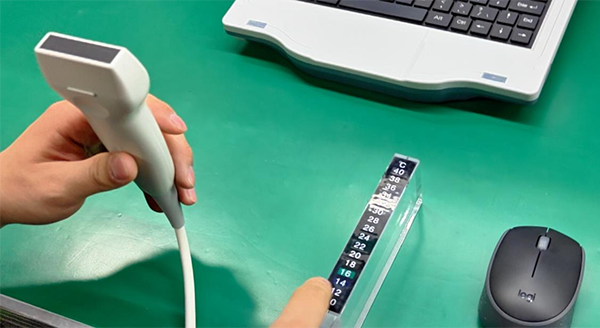
Mold placement: Place the calibration mold horizontally on the probe, gently press the mold to eliminate air bubbles on the contact surface, and ensure that the mold is fully in contact with the probe.
Start calibration: On the main interface of the system, enter “Calibration”, fill in the ambient temperature according to the deepest temperature value of the calibration module’s temperature value, and click “Start Probe Calibration”. After that, the device will automatically conduct the measurement.
Result verification: The system automatically calculates the error, which must meet the standard of “error ≤±0.5%”. If the calibration fails, first check whether the mold is placed horizontally and whether the coupling agent is uniform. After ruling out the basic operation problems, try again.
Support and guarantee system: Lower the threshold for professional operations
Pinyuan Medical provides full-process support for the calibration stage, addressing the practical concerns of clinical personnel
Special training during installation period: When the equipment is delivered, technicians will provide practical guidance on calibration, covering the usage norms of the mold, control of environmental parameters, error detection skills, etc., to ensure that the operators master the core steps.
Daily after-sales response: In case of issues such as “calibration failure prompt” or “abnormal data”, remote guidance can be obtained through the manufacturer’s 7× 24-hour after-sales channel. For complex faults, on-site maintenance can be applied for.
Calibration cycle: The manufacturer recommends the calibration cycle based on the frequency of clinical use.
Calibration is “professional but not complicated”. For trained medical staff, the calibration of Pinyuan Medical’s ultrasonic bone densitometer can be completed within 1 to 2 minutes according to the instructions and training requirements. Moreover, the calibration standard fully meets the metrological requirements of the test and can effectively ensure the reliability of clinical screening data.
Post time: Oct-11-2025