
As the frontline of primary medical services, community hospitals undertake the crucial responsibility of routine healthcare and health monitoring for children and adolescents within their jurisdiction. Bone age assessment is a key method for evaluating the developmental maturity of children, holding significant importance for early warning of growth abnormalities and providing personalized health guidance. The X-ray Bone Age Assessment Device BAD-Q1, with its design philosophy and functional features tailored for primary care settings, offers a feasible equipment solution for community hospitals to enhance their child health service systems.
Regarding its suitability for community hospitals, the design of the BAD-Q1 X-ray Bone Age Assessment Device fully aligns with the practical needs of primary care. The device features a fully enclosed lead-protected structure coupled with a dedicated lead curtain, providing dual-layer radiation protection. This eliminates the need for constructing additional lead-lined rooms, allowing deployment in ordinary rooms, thereby effectively saving limited space and construction costs for community hospitals. In terms of operation, it is equipped with a triple-positioning system comprising a hand positioning diagram, a monitoring screen for positioning surveillance, and software video monitoring. This system assists operators in achieving quick and accurate positioning, reducing the likelihood of repeat scans. Furthermore, its interface is designed to be simple and intuitive, enabling primary healthcare personnel to operate it proficiently after basic training. Additionally, the device supports both wired and wireless data transmission modes, facilitating smooth integration with the community hospital’s information management system and aligning with the digitalization needs of primary healthcare.
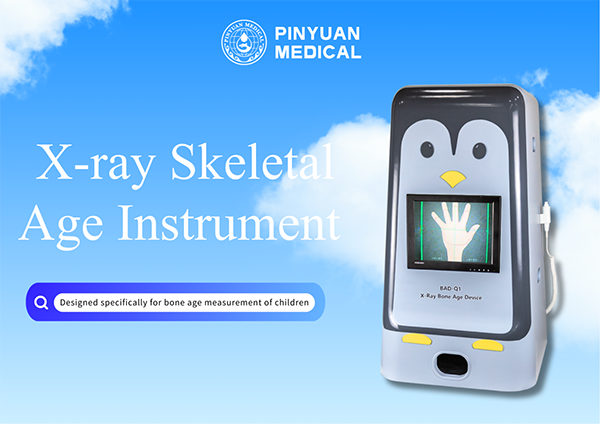
In community healthcare practice, the BAD-Q1 X-ray Bone Age Assessment Device serves as an essential tool for primary-level skeletal health management, leveraging its precise detection technology and user-friendly operational features. Its primary applicable scenarios encompass the following three key areas:
1.Routine Growth and Development Monitoring for Children and Adolescents
In scenarios such as community child health follow-ups and regular physical examinations for school-age children, the BAD-Q1 X-ray Bone Age Assessment Device can capture image data of the hand-wrist bone region. By applying widely recognized bone age assessment standards such as the China 05 and TW3 methods, it generates comprehensive growth and development assessment reports. These reports include indicators such as the alignment between skeletal development progress and chronological age, analysis of genetic height potential, and scientific prediction of adult height. This information enables healthcare providers to offer parents personalized recommendations regarding nutrition, exercise guidance, sleep management, etc., supporting the scientific growth of children and adolescents.
2. Early Screening for Abnormal Growth and Development and Support for Intervention
For children within the jurisdiction exhibiting insufficient annual height gain, consistently falling at the lower limit of the normal height range for their age, or showing early signs of secondary sexual characteristics, the BAD-Q1 X-ray Bone Age Assessment Device utilizes its multi-algorithm joint assessment capability to accurately identify signals of abnormal development such as advanced or delayed bone age. This objective detection data provides a scientific basis for the early identification of issues like precocious puberty or growth hormone deficiency. It assists primary care doctors in making timely referrals or offering intervention guidance, helping to establish a frontline defense for child health screening at the community level.
3. Empowering Community Public Health Services and Health Education
The BAD-Q1 X-ray Bone Age Assessment Device can serve as a valuable tool for community health education initiatives, enhancing the practicality and impact of public health services. Community medical institutions can regularly organize activities such as “Children’s Growth and Development Charity Consultations” or “Adolescent Height Management Science Popularization Lectures.” By offering on-site bone age assessment services during these events, they can visually demonstrate skeletal development patterns and the importance of growth monitoring to parents, fostering scientific parenting concepts and promoting the dissemination and application of child health management knowledge.
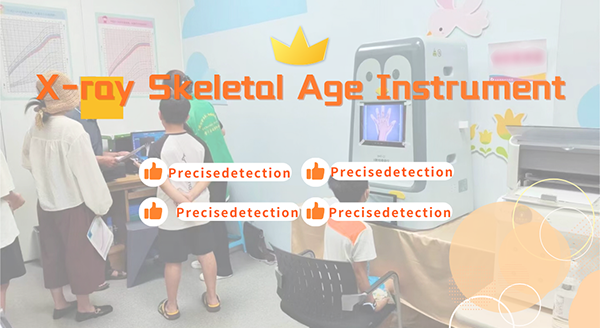
Furthermore, the child-friendly design of the BAD-Q1 X-ray Bone Age Assessment Device enhances the pediatric service experience in community settings. The device adopts a cartoon penguin shape with soft colors. Coupled with clinical protocol parameters specifically set for children, it minimizes overexposure and effectively alleviates anxiety in young children during examinations. Simultaneously, the device boasts continuous operation capability, meeting the demands of large-scale screening events in a single day. Beyond daily outpatient use, it is well-suited for centralized screening scenarios organized by the community, such as school physical examinations or child health surveys. The device supports both simplified and detailed report modes, allowing flexible switching based on community diagnostic needs to balance the different requirements of efficient screening and precise assessment.
In summary, the PinYuan Medical X-ray Bone Age Assessment Device BAD-Q1, with its characteristics of low-radiation protection, user-friendly operation, and broad scenario adaptability, precisely matches the service positioning and operational conditions of community hospitals. It demonstrates practical value in scenarios such as child growth monitoring and abnormal development screening. By aiding community hospitals in improving their child health service capabilities, it provides ongoing support for the healthy growth of children and adolescents within their jurisdiction.
Post time: Jan-15-2026