
In the selection of medical equipment, the internal design and detail handling of the product often reflect its performance and quality more truly than the parameters themselves. The newly launched portable dual-energy X-ray bone densitometer by Pinyuan Medical is precisely such a product that integrates rigorous thinking into every detail. Let’s set aside the macro overview and delve into a few key details to see how it interprets the word “reliable”.
Detail One: Safety begins with every “closure” and “shielding”
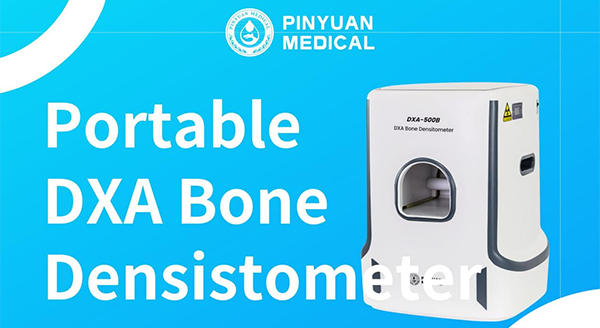
Safety is not an abstract concept but a commitment composed of specific physical structures. The portable dual-energy X-ray bone densitometer DXA-500B adopts an integrated fully enclosed body. This is not only a simple appearance, but more importantly, it restricts the radiation escape path from the source. Its multiple built-in protective structures, like elaborately designed layers of barriers, are dedicated to strictly controlling the radiation dose within the necessary range. This collaborative protection thinking from the overall architecture to internal components reflects a practical consideration of the safety of the operating environment.
Detail Two: Accuracy, rooted in the “guidance” logic of triple parallelism
The repeatability of measurement is highly dependent on the consistency of each positioning. For this purpose, DXA-500B has constructed a three-dimensional guidance system:
Physical grip: Provides a stable grip point that conforms to ergonomics, reducing natural offset caused by unstable holding.
Real-time video: It transforms the operation field of view from external blind operation to intuitive monitoring on the screen, facilitating immediate fine-tuning.
Clear positioning lines: Provide a definite reference on the video screen.
These three are not simply superimposed but form a closed-loop process of “stability – observation – calibration”, transforming experience-dependent positioning into standard operations with a basis to follow, providing a reliable premise for subsequent analysis.

Detail Three: Precision, thanks to the pre-correction of image “uniformity”
The accuracy of any computational analysis is based on the quality of the input data. The software system of the dual-energy X-ray bone densitometer has taken this into account at the core algorithm level and particularly integrated the non-uniformity correction (NUC) technology. This means that before generating the bone density report, the system will first preprocess the original forearm image, actively optimizing any possible uneven imaging issues, thereby providing a more solid and consistent image foundation for the final quantitative calculation. This step of “preprocessing” demonstrates its pursuit of reliable data origin.
From the meticulous layout of the protective structure to the multiple guidance of the positioning process, and then to the active optimization of image quality at the algorithm level, the portable dual-energy X-ray bone densitometer DXA-500B from Pinyuan Medical demonstrates systematic design thinking in every minute detail. These details all point to a core goal: to make every measurement more trustworthy through perceptible and verifiable design improvements. For medical scenarios that seek both operational simplicity and reliable results, this craftsmanship hidden in the details might just be a solid footnote to its value.
Post time: Dec-11-2025