
Compared to traditional large-scale bone densitometers, portable devices offer significant advantages in flexible deployment and easy mobility. These features make them better suited for diverse scenarios such as fixed-site testing within examination centers and mobile screening using medical vehicles. Among numerous equipment suppliers, PinYuan Medical’s two portable bone densitometers stand out due to their strong scenario adaptability and stable performance, establishing them as preferred solutions for physical examination centers.
PinYuan Medical (Jiangsu) Co., Ltd. specializes in the research, development, and production of bone health detection equipment. Their offerings include the portable ultrasonic bone densitometer BMD-A3 and the portable dual-energy X-ray bone densitometer DXA-500A. Both products are optimized for the specific needs of examination centers and come highly recommended.
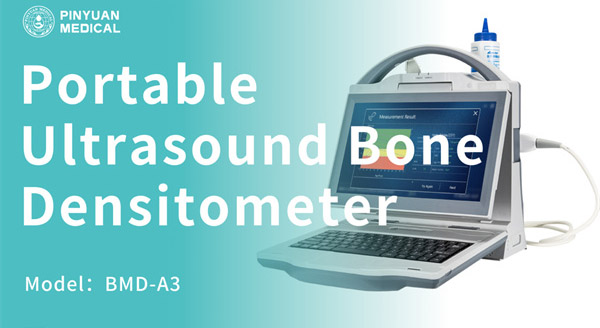
Portable Ultrasonic Bone Densitometer BMD-A3: The Choice for Radiation-Free, Efficient Screening
This device utilizes ultrasound detection technology, which is entirely radiation-free and non-invasive. It is safe for all age groups, including children, pregnant women, and middle-aged or elderly examinees. In terms of portability, the unit weighs only 4.3 kg and is comparable in size to a laptop, allowing a single person to carry it effortlessly. It requires no fixed installation site, enabling flexible placement in various testing areas within an examination center. It can also be easily loaded onto mobile medical vehicles for outreach screening, perfectly aligning with the need for mobile services.
Regarding detection efficiency, the BMD-A3 can effectively handle high-volume screening demands during peak examination periods, enhancing the overall throughput of the center. Its user-friendly design includes a probe navigation function, allowing even non-specialized personnel to operate it with ease, thereby significantly reducing training costs. The device employs a high-shielding, multi-point signal contact mode paired with a multi-sensor probe. This design, enhanced by axial transmission and dual-transmit/dual-receive technology, effectively isolates external signal interference. It improves the sensitivity and stability of ultrasound signal reception, resulting in denser valid data and ensuring the accuracy and reliability of test results. For data support, the device features independent pediatric and adult reference databases. It automatically matches the appropriate database based on the examinee’s age and generates a personalized report containing key indicators such as T-scores and Z-scores, perfectly meeting the requirement for full-population bone density screening in examination centers.
Portable Dual-Energy X-ray Bone Densitometer DXA-500A: A Precision Diagnostic Tool
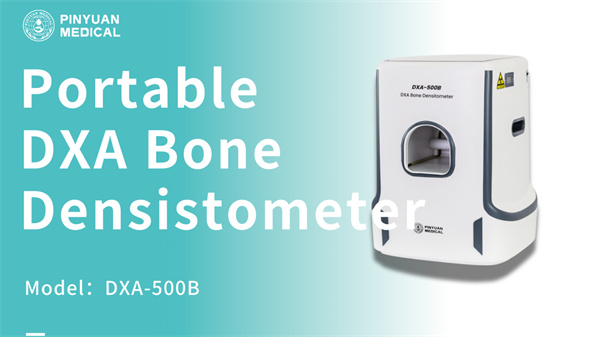
For examination centers that require precise diagnosis of osteoporosis and monitoring of treatment efficacy, the DXA-500A is the more suitable choice. This device employs Dual-Energy X-ray Absorptiometry (DXA), the clinical “gold standard” technology. Its measurement results can be directly used as a basis for the World Health Organization (WHO) diagnostic criteria for osteoporosis. It provides examinees with precise core indicators such as Bone Mineral Density (BMD), T-scores, and Z-scores, offering reliable data to support subsequent health interventions.
The DXA-500A represents a significant breakthrough in portability and scenario adaptability. Traditional DXA devices are often bulky and require dedicated lead-lined rooms. In contrast, this device weighs only 19.8 kg and has compact dimensions of 33.5×36.5×47.5 cm, allowing one person to move it easily. It features a lead-room-free design, coupled with a remote operation mode using the main unit and a laptop, greatly reducing site deployment requirements and minimizing radiation exposure risks for both medical staff and patients. The device supports both wired and wireless connection modes, enabling flexible deployment in any testing area of an examination center. It is also ideal for loading onto medical vehicles to provide mobile services such as community group screenings or testing in remote areas.
In terms of detection efficiency, the DXA-500A integrates cone-beam imaging technology with a dedicated compensation algorithm to achieve a rapid scan time of less than 4 seconds, while ensuring high precision and excellent reproducibility of the measurement data. Its innovative triple-positioning system—combining a physical handgrip, video monitoring, and positioning lines—ensures consistent positioning for each test. This enhances data comparability, making the device particularly suitable for long-term tracking of bone health changes in examination populations.
Key Recommendations for Purchasing a Portable Bone Densitometer
When selecting a portable bone densitometer, an examination center should make a decision based on its core operational needs:

If the primary need is for large-scale health screening, with an emphasis on the device being radiation-free, highly mobile, and efficient, the PinYuan Medical BMD-A3 ultrasonic bone densitometer is the preferred choice. It meets the demands of high-frequency testing in scenarios like mobile medical vehicle screenings and community group check-ups.
If the center requires precise diagnosis of osteoporosis, monitoring of treatment efficacy, or serves a population with a high proportion of at-risk individuals, the PinYuan Medical DXA-500A dual-energy X-ray bone densitometer is recommended. Its diagnostic-grade precision enhances the professionalism and competitiveness of the examination services offered.
Furthermore, when procuring a portable bone densitometer, it is crucial to verify the product’s compliance with medical device registration certificates and to assess the manufacturer’s capabilities in technical training and after-sales maintenance to ensure the stable, long-term operation of the equipment. Centers should also comprehensively consider factors such as daily testing volume, site conditions, and budget to select the product that best fits their specific operational requirements.
Post time: Jan-15-2026